Mali - Bamako's new levers: drones, religious discourse and Russian diplomacy Spécial
 © DR
© TDR
In Mali, recent developments highlight the multi-layered strategy pursued by the transitional authorities to assert the presence of the State. On the military front, despite criticism, drones have established themselves as a decisive weapon. At the same time, Bamako is investing in other arenas: the religious sphere, with a reference document aimed at deconstructing extremist discourse, and the judicial sphere, with the resumption of criminal hearings in Timbuktu. On the diplomatic front, the Russia-Africa summit in Moscow allowed General Assimi Goïta to reaffirm a strategic partnership with Russia that he now wishes to extend well beyond security matters alone.
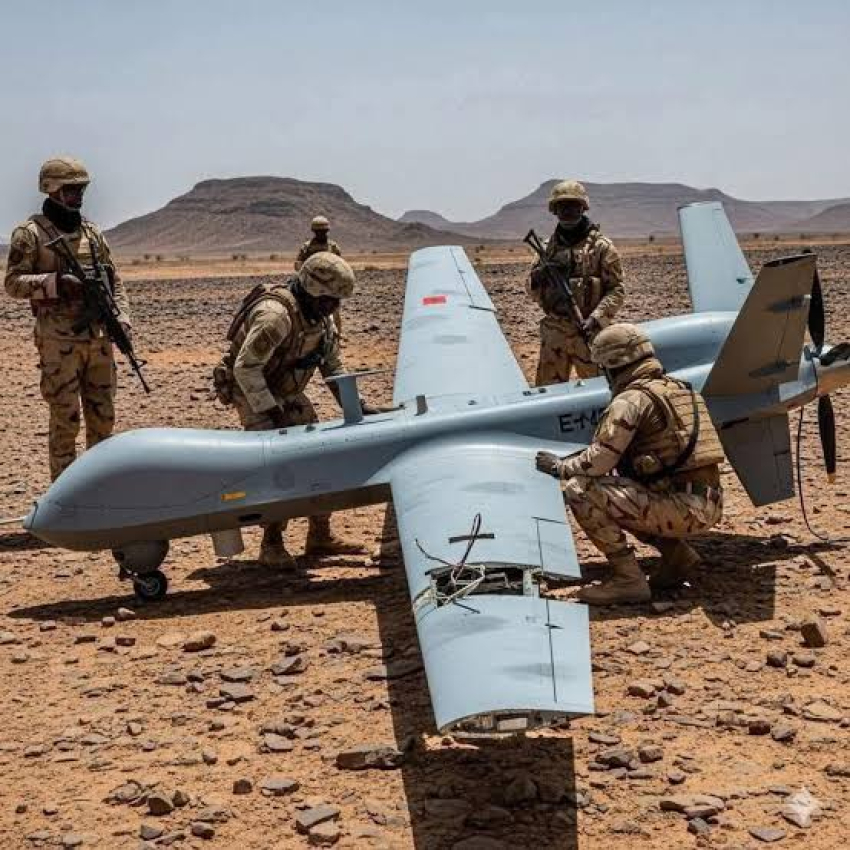
FAMa drones: a double-edged sword?
According to a six-month investigation conducted by Jeune Afrique in collaboration with Bellingcat and The Sentry, the journalists analysed 60 drone strikes carried out by the Malian army and its Russian partners from Africa Corps between September 2023 and September 2026. Twelve of these strikes were independently reconstructed using geolocation, satellite imagery, testimonies from the field, footage filmed from the drones and ground-level images. The investigation finds that drones have “profoundly transformed the war in Mali”, insofar as a quarter of the recorded victims are civilians. It points to a lack of precise intelligence, a flawed target identification process and loose rules of engagement on the part of the Malian army and its partners. It also mentions the possibility of mixed crews, reportedly made up of a Malian pilot assisted by a Turkish adviser, with validation by a Russian command structure.
Moreover, according to the same investigation, the drone could be regarded as an effective media weapon, insofar as a successful strike would serve as living proof of the State's power and of its knowledge of the territory. The problem lies in the disregard for collateral damage, such as the destruction of crops, the death of livestock or the mass exodus of populations. The methodology used in this investigation, particularly open-source investigation, is rigorous and rare on a subject so sensitive and difficult to access in the Sahel. The focus on civilian casualties and humanitarian impacts brings a useful factual dimension in the face of official narratives of “reconquest”. However, of the 60 drone strikes analysed, only twelve could be independently reconstructed, leaving a margin of uncertainty over the corpus as a whole. Furthermore, Jeune Afrique is often criticised for an editorial line sometimes seen as unfavourable to the AES and its partners. Overall, however, this is an investigative piece that sheds light on a little-known aspect of the war in Mali, while recalling the inherent limits of any investigation into opaque conflict zones.
Finally, the “Bamako Document for the Deconstruction of Extremist Discourse”
In order to prevent extremist discourse and promote a religious discourse conducive to peace and responsibility, the High Islamic Council of Mali, acting on the instructions of President Assimi Goïta, handed Prime Minister Abdoulaye Maïga the “Bamako Document for the Deconstruction of Extremist Discourse”. The Malian authorities hope for a wide dissemination of this text among Muslim communities, as well as the involvement of religious organisations, civil society and public institutions. The initiative is part of the work of the Committee for Reflection on the Prevention of Unrest in the Religious Sphere, set up at the initiative of the Head of State. Through this document, the State shows that the religious dimension is taken into account and is of real importance in complementing the security approach. This inclusive approach is significant, as it can limit the risk of recruitment of potential jihadists at the source. However, the document's effectiveness will depend on its ability to reach its target audiences and on a wider dissemination of its full text.
Restoring judicial authority in Northern Mali
The Criminal Chamber of the Timbuktu High Court opened, on 27 October 2026, a session devoted to four criminal cases, under the theme “Local justice serving citizens and the rule of law”. The ceremony took place under the authority of the regional governor. The aim was to underline the importance of bringing justice closer to citizens, speeding up the processing of cases and upholding the rights of the defence and of victims, as part of the judicial reforms under way in Mali.
As Northern Mali is an area of insecurity, the holding of these criminal sessions symbolises the will to restore the presence of the State, in this case that of the judicial authority. It signals the return of the State to the recaptured or stabilised regions of the North, even though the limited number of cases and the lack of detail on their nature make it impossible to assess their concrete impact.
Mali-Russia cooperation at its best
On the sidelines of the Russia-Africa summit in Moscow, President Assimi Goïta welcomed progress in cooperation with Russia in the military, economic and energy fields. He highlighted Russian support in supplying equipment and aerial assets, which has strengthened the capabilities of the Malian Armed Forces and fostered a gradual return of State authority. General Assimi Goïta advocated a multipolar international order based on sovereignty and non-interference. He said he was open to expanding cooperation, notably to intelligence, cybersecurity, territorial surveillance, mineral processing, civil nuclear power and solar energy. This discourse is fully consistent with Mali's strategic reorientation since 2021-2022. Russia is presented as the best partner, in a “win-win” cooperation that respects sovereignty, unlike former Western partners such as France. The desired expansion into energy and mining shows that Bamako wants to go beyond security alone in its partnership with Russia.
In the same vein, the Malian president held talks for more than an hour with his Congolese counterpart, Denis Sassou Nguesso, again on the sidelines of the Russia-Africa summit in Moscow. Security issues in the Sahel and in Africa were at the heart of the discussions. The two Heads of State stressed the importance of strengthening solidarity among African States to better respond to threats, and underlined that the continent's security rests above all on unity and cooperation rather than isolation. President Goïta did not fail to recall the importance of respecting the sovereignty and choices of the Malian people.
Dernier de Timbuktu Institute
- Nigeria: between health vigilance and a reshaping of the security apparatus
- Nigéria : entre vigilance sanitaire et recomposition du dispositif sécuritaire
- Cameroon - The opposition under pressure, with Biya's succession in the background
- Cameroun - L’opposition sous pression, la succession de Biya en filigrane
- Chad-Niger: tensions amid regional realignments