 French
 Arabic
 English
 Portuguese
 Spanish
 Swahili


Sacré-Coeur 3 – BP 15177 CP 10700 Dakar Fann – SENEGAL.
+221 33 827 34 91 / +221 77 637 73 15
contact@timbuktu-institute.org

Ce sont les Djeliw qui nous ont toujours appris que «le monde est vieux, mais l’avenir sort du passé !». Le Mali ira chercher la paix dans ses tripes, dans ses tréfonds et l’offrira en trésor à l’Afrique qui retient son souffle et au monde qui nous regarde !
Nous, qui sommes tous Maliens !
Le pays par excellence du « Sinankuya », permettant la paix même dans l’adversité, est une terre de paix, d’hommes de paix, valeureux, créatifs capable de génie, surtout du génie du dialogue.
Ce peuple du Mali est capable de paix des braves !
La grandeur historique d’un pays et d’un peuple ne saurait mentir. Elle est une force motrice pour les grands sursauts. Il en faut aujourd’hui !
Les descendants de ces fondateurs d’empires ne peuvent être que de grands hommes d’Etat malgré les vicissitudes de l’Histoire.
N’oublions jamais que ce peuple malien dont les ancêtres furent à l’origine de l’Empire du Wagadou ou Gana, qui ont réussi à unir les peuples de notre sous-région a été capable du meilleur de l’Afrique. Il ne peut être à l’origine du pire : la survie du Mali est celle de notre région. Sa paix est celle de tout le monde !
Héritiers comme nous autres Africains de ceux qui dès 1236 ont proclamé la Charte du Mande à Kouroukanfouga, les Maliens sont avant tout des citoyens ! Ils en ont incarné l’esprit. Ils n’ont point attendu que plus de 700 ans plus tard, une Déclaration consacre les Droits de l’Homme de manière universelle !
Pays continent aussi bien par son étendue que par sa densité culturelle, mosaïque harmonieuse et symbole de l’Afrique unie dans sa diversité : Mali Baa !
Notre pays, parce qu’elle est l’Afrique ! Pays entre autres des Bamananw, Bwa, Mandenkaw, Soninké, Fulbé, Dogon, Kel Tamashek, Sonraï, Bozo, Sénoufo, Tekurari, Minyankaw, Khassonké, Touaregs, ayant conjugué le tréfonds culturel africain dans ce qu’il a de plus authentique, puisé de la culture musulmane un viatique spirituel, consigné à Toombouctou, Djenné et ailleurs le savoir du Moyen-Age et à l’origine de l’Alphabet Tifnagh, unifié Bambara, Peul, Dogon et, entre autres, les Imochar ou Imaggaren…
Parce que braves, les Maliens sont femmes et hommes de paix !
Même au fond de la nuit, habité par le doute et le rêve légitime de lendemains meilleurs d’un « Mali Koura », se remettre debout et marcher n’est plus de l’ordre du miracle mais du possible.
Parce que certain qu’il décryptera dûment le message, Timbuktu Institute a voulu se joindre à la voix de Balla Fasséké, des familles fondatrices de Bamako, et rappeler au Mali sa responsabilité historique de construire son avenir dans la paix !
Par sa voix, l’Afrique veut tendre fraternellement et symboliquement à un peuple ami et frère, cette barre de fer issue de ce matériau tiré des entrailles de cette riche terre du Mali pour qu’à l’instar de Soundjata, il se lève pour de bon et marche pour la paix, la grandeur et la Renaissance de l’Afrique !
Par Morgane Ferreira
« Il est à saluer fortement que l’Italie et ses décideurs fassent l’option d’écouter le terrain et d’associer les chercheurs africains dans la réflexion et l’élaboration des stratégies ; cela relève d’un bel esprit de co-construction qui pourrait aider à éviter les incompréhensions et les préjugés qui ont été déplorables pour certaines politiques de coopérations », dira Bakary Sambe à l’entame de son propos.
Fin juillet 2020 le Directeur du Timbuktu Institute est intervenu en tant qu’expert à la web-conférence « sécurité dans le Sahel : conférence-débat entre des experts italiens et africains », organisé par l’Italia-Africa Business Webinar, avec Mr Cleophas Adrian Dioma et animé par Mr Jean Leonard Touadi. L’objectif de cet important webinar était de cerner les enjeux sécuritaires auxquels fait face le Sahel et de permettre aux expert.es de fournir leur analyse de la situation actuelle. Pour Dr. Bakary Sambe, « ce partenariat dans le domaine de la recherche s’inscrit en droite ligne de la suite des échanges lors de la rencontre entre une délégation de l’Institut et la vice-ministre italienne des Affaires étrangères et de la coopération internationale, Mme Emmanuela Del Ré lors de sa visite au Sénégal en janvier 2013 ».
Entouré de Dr. Mahamoudou Savadogo, chercheur sur les extrémismes violent (Institut of Security Studies), Mr. Giuseppe Mistretta, directeur Afrique subsaharienne du Ministère des affaires étrangères Italien, Dr. Niagalé Bagayoko, présidente de l’African Security Sector Network, Mr. Sergio Vento, ex-ambassadeur et actuel président de Vento&Associati ainsi que Mr. Camillo Casola, chercheur (Afrique- ISPI), Mr. Sambe a pu livrer une analyse sur les leçons et échec que les précédentes approches sécuritaires ont apporté à la lecture des conflits sahéliens.
Pour rappel, le Sahel connait un ancrage fort de présence de groupes terroristes armés, divisés entre les groupes affiliés à Al Qaeda, avec notamment le groupe appelé « JNIM » acronyme de l’arabe « Jama'at Nusrat al-Islam wal Muslimin » (litt. « Groupe de Soutien à l’Islam et aux Musulmans ») et l’État Islamique, avec sa branche du Grand Sahara – sous le nom de EIGS. Cette présence terroriste armée a été au cœur des préoccupations internationales, notamment dû au fait que cela est perçu comme facteur principal d’immigration. La France a ainsi largement soutenu les forces armées du G5 afin de lutter contre le djihadisme violent et est maintenant principalementrejoint par l’Italie et l’Allemagne. Le débat a commencé avec une mise en cause de cette question d’urgence d’agir maintenant sur les flux migratoires liés aux terrorismes, notamment avec la récente implication italienne.
Il était d’abord question de relativiser la quantité de flux migratoire vers l’Europe en rappelant que la migration est avant tout un phénomène qui se déroule entre les pays de la région. D’ailleurs, lire la situation de flux migratoire comme résultante directe de l’insécurité de la région n’est pas suffisant. Les experts se sont accordés pour souligner l’importance d’une lecture multidimensionnelle des conflits au Sahel : si le terrorisme est un facteur d’insécurité non-négligeable, il reste important de comprendre que ce n’est plus le seul à créer une instabilité dans la région. Les conflits intercommunautaires ont pris une importance dans les enjeux sécuritaires, avec notamment la création de milices communautaires ou de groupes d’auto-défense qui commettent aussi certaines exactions au nom de la défense de leur communauté. L’installation de groupe criminel favorise aussi un climat de violence et de crimes dans la région. Enfin, Mme Bagayoko a très justement souligné qu’il ne fallait pas oublier les exactions et crimes commis par les forces armées déployés, notamment au Burkina Faso, Mali et Niger.
Dr. Sambe a appuyé ce point en acceptant qu’il fallait certes trouver des solutions pour plus de sécurité dans la région, mais qu’à ce jour la présence militaire n’a pas été suffisante dans le combat pour la stabilité. Il faut d’abord noter que l’intervention militaire de la communauté internationale s’est faite avec un retard de 40 ans dans la région du Sahel. La communauté internationale n’a pa s été au rendez-vous lors des grandes sécheresses des années 1970 pendant que l’Europe et les Etats-Unis étaient frappés par la crise pétrolière et financière. La crise s’est accentuée, ensuite, avec les politiques d’ajustement structurel qui ont positionné d’autres acteurs tels que les ONG islamiques au détriment des Etats fragilisés.
En plus de ce retard, il y a aujourd’hui, une multiplication d’acteurs et de stratégies européennes sans coordination au moment où les groupes terroristes tissent leur toile et étendent leurs réseaux en créant d’autres épicentres. À l’heure actuelle il y a 19 approches différentes proposées par la communauté internationale et les pays du Sahel pour gérer la crise. Cette diversité de méthodes d’actions ne permet pas, dans les faits, d’améliorer la situation car lorsque la communauté internationale tente de répondre à la menace, les groupes djihadistes eux s’organisent et se multiplient.
Ainsi, le sentiment d’insécurité des populations est accru car la militarisation de la région ne s’est pas accompagnée d’une baisse d’intensité dans la menace terroriste. C’est ce sentiment d’insécurité qui va alimenter la volonté des populations locales de se défendre par eux-mêmes et ainsi user de leurs propres moyens pour le faire. Cela a pour conséquence une communautarisation de la sécurité et donc une crise de confiance envers les approches purement militaire.
Il faut noter que les échecs des opérations militaires ne sont pas des nouveautés pour l’expert, car pour lui, la réponse purement militaire ne représente pas une solution en soi. Elle s’attaque aux symptômes et non à la racine du mal bien qu’il faille gérer les urgences sécuritaires. Ce ne sont pas des solutions suffisantes au vu de la complexité des conflits sahéliens car une approche militaire ne prend pas en compte la complexité de lecture des conflits de la région. Il faut pouvoir proposer une réponse éducative et holistique pour contrer le terrorisme et la violence. Et cela ne pourra se faire qu’avec la prise en compte et l’écoute des experts africains. Le sentiment de manque de confiance envers les approches purement militaire est rejoint par un sentiment de défiance envers les institutions et la communauté internationale. Il y a un fossé de compréhension entre les acteurs et les populations : les États du Sahel et la communauté internationale proposent des approches sécuritaires ne prenant pas forcément en compte les besoins et attentes des populations locales.Cette difficulté à intégrer une démarche civilo-militaire dans les solutions proposées crée un « conflit de perception » et facilite l’implantation des de l’extrémisme violent, car les terroristes au contraire, restent proches des populations locales.
Ainsi sans l’inclusion et la valorisation de l’expertise africaine et la création d’un dialogue constructif entre le Nord et le Sud, les approches internationales de résolutions de conflits resteront peu effectives sur la racine des problèmes. Il faut que la communauté internationale puisse tirer des leçons de ces précédents échecs, c'est-à-dire sortir des schémas préconçus sur la région, en prenant en compte l’aspect multifactoriel des conflits et en rendant majoritaire les experts africains et les populations locales dans la discussion.
Mr. Sambe a donc rappelé aux experts italiens que la place de l’Italie dans cette discussion -notamment dans une démarche de ralentissement de l’immigration, ne pourra être qu’avantagée par une démarche plus développementaliste et basée sur l’apport d’une valeur ajoutée par rapport aux solutions actuelles. A ce sujet, il souligne d’ailleurs que la valeur ajoutée de l’Italie dans son engagement au Sahel serait de mitiger les stratégies actuelles – tournées vers le tout-militaire- et qui ne produisent pas, pour l’heure, les résultats escomptés.
*Morgane Ferreira est actuellement stagiaire au Timbuktu Institute-African Center for Peace Studies travaillant sur les dynamiques de genre en rapport avec les questions de paix et de sécurité mais aussi l’appui aux stratégies de communication dans les programmes de stabilisation des zones post-conflits. Ce compte-rendu a été réalisé dans le cadre de ce stage
A l’heure où l’essentiel des réflexions semblent orientées vers la COVID-19 et ses innombrables retombées sur tous les secteurs, les groupes terroristes et les réseaux transnationaux menaçant la stabilité de la région sont toujours à pied d’œuvre comme le montrent les récentes attaques dans la zone des trois frontières du Liptako Gourma.
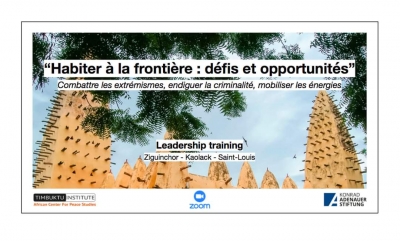
Saisissant l’importance de la prévention malgré la prédominance des stratégies du tout-sécuritaire ainsi que le renforcement des capacités des acteurs, Timbuktu institute – African Center for Peace Studies– en partenariat avec la Fondation Konrad Adenauer, a lancé une série de sessions de formation des jeunes leaders actifs dans les régions frontalières sur les enjeux transnationaux, plus précisément à la criminalité transnationale, aux extrémismes et ainsi pousser la réflexion sur leurs défis et opportunités. La porosité des frontières, la négligence de telles problématiques cruciales en raison de la pandémie, la montée des extrémismes sont entre autres autant de facteurs justifiant la tenue d’ateliers de formations qui cherchent à réfléchir sur les défis et opportunités qui se présentent aux populations transfrontalières.
La session de formation inaugurale aura lieu ce mercredi 12 août 2020 en ligne sur le thème « Habiter à la frontière, défis et opportunités. Enjeux transnationaux, combattre les extrémismes et la criminalité transnationale ». Elle ciblera des leaders de la région de Ziguinchor et relevant de diverses catégories socioprofessionnelles. Les régions de Saint-Louis et Kaolack bénéficieront de leurs ateliers les 19 et 26 août prochains. La formation sera animée par le Dr. Bakary Sambe, Directeur du Timbuktu Institute et Monsieur Assane Dramé, Expert des questions juridiques et responsable du Pôle contre-terrorisme, criminalité transnationale organisée et problématiques migratoires au Timbuktu Institute. Elle sera facilitée par Mlle. Yague Samb, Responsable Pôle Etat de droit, gestion des conflits et dialogue politique appuyée par l’équipe technique et de communication digitale.
L’atelier se voudra interactif au regard du temps important qui sera consacré aux débats mais aussi aux partages d’expériences qui démontrent la réalité des menaces transnationales.
L’objectif est qu’à l’issue de cette session de formation, les participants en sortent outillés sur la question des enjeux et menaces transnationaux pour ainsi répliquer ces formations auprès des populations locales. Les jeunes leaders seront ainsi confrontés à des expériences de terrain mais aussi des cas pratiques à partir des récentes interventions des équipes de Timbuktu Institute aussi bien au Sahel, dans le Bassin du Lac du Tchad mais aussi en Afrique cotière.
Par Dr. Issa M. KANTÉ*
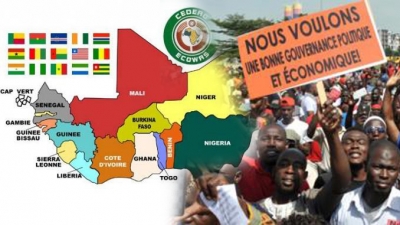
Le mardi 18 août 2020 survint au Mali un coup d’État orchestré par des officiers de l’armée réunis en Comité national pour le salut du peuple (CNSP). Les condamnations par la communauté internationale ne se sont pas fait attendre, en commençant par la CEDEAO (Communauté économique des États de l’Afrique de l’Ouest), suiviepar l’Algérie, les États-Unis, la France, l’ONU, l’Union européenne, etc. Cependant, on peut faire un distinguo entre ces réactions, car il est une chose de condamner le coup d’État et d’appeler à un retour immédiat ou rapide à l’ordre constitutionnel, il en est une autre que d’imposer un isolement total à tout un peuple, qui souffre déjà depuis des années. Cette dernière option est clairement celle que prône la CEDEAO ; l’Union africaine semble aussi tenir une ligne assez ferme, à voir jusqu’où ira-t-elle. Après tout, on pourrait penser que la CEDEAO a bien raison d’adopter cette position, mais avant de tirer une telle conclusion, arrêtons-nous sur quelques passages et arguments de son communiqué[1] contre ce putsch, en les mettant en perspective par rapport à la situation qui prévaut au Mali.
Peut-on parler de paix et stabilité au Mali ?
Le premier passage du communiqué de l’organisation sous-régionale qui mérite réflexion est l’idée que ce coup de force des militaires « est de nature à avoir un impact négatif sur la paix et la stabilité au Mali et dans la sous-région ». Cela sous-entendrait-il que le Mali connait « la paix et la stabilité » ? La réponse est clairement non quand on est au courant de la situation dans le nord (nord-est) et le centre du pays. Le seul exemple des massacres du village d’Ogossagou, dans la région de Mopti au centre du pays, suffit pour illustrer cette sinistre réalité. En mars 2019, ce village a connu le massacre d’environ 160 personnes, révélant ainsi au grand jour les graves problèmes d’insécurité dans cette zone. A nouveau en février 2020, dans la même localité, 35 civils ont été tués et 19 sont toujours portés disparus. Inutile donc d’énumérer les attaques terroristes récurrentes contre les FAMa (Forces Armées Maliennes) et les populations civiles.
La CEDEAO, le Mali et l’ordre constitutionnel
Lorsque la CEDEAO« dénie catégoriquement toute forme de légitimité aux putschistes et exige le rétablissement immédiat de l’ordre constitutionnel », on peut se demander s’il y avait un véritable « ordre constitutionnel » au Mali. Quand on sait que l’institution qui était la garante même de la Constitution était contestée pour avoir rendu plusieurs décisions dont le but était de favoriser le président et son camp. Le dernier exemple en date fut la proclamation biaisée (euphémisme) des résultats des élections législatives de mars et avril 2020 par la Cour constitutionnelle. C’est cela même qui fut l’élément déclencheur de la contestation, et la « dissolution de fait » de ladite Cour, le 11 juillet dernier, par le président IBK (Ibrahim Boubacar Keïta) n’a pas suffi pour sauver son pouvoir. Certes, il existe d’autres raisons plus profondes et complexes, parmi lesquelles : la crise sécuritaire dans le pays, la crise endémique de l’école, la corruption, le népotisme, le chômage, etc. Des défis pour lesquels IBK avait pourtant été confortablement élu en 2013 pour son premier mandat. Disait-on à l’époque au Mali et ailleurs que c’était « un homme à poigne », donc « l’homme de la situation » pour régler la crise sécuritaire dans le nord du pays, entre autres.
Au contraire, il est à noter que le temps a donné raison à ceux, moins nombreux à l’époque, qui étaient plus que sceptiques à l’idée qu’IBK puisse être une option viable. Néanmoins, à sa décharge l’histoire retiendra que la minorité sceptique de l’époque était obligée d’admettre que les quelques leaders politiques qui auraient pu apporter des solutions concrètes au pays n’avaient aucune chance en 2013 de remporter la majorité des suffrages exprimés. Le peuple dans une large proportion, à sa tête certains leaders d’opinion bien écoutés, n’avait qu’un mot à la bouche IBK, tous pour IBK. Certains diront même que les ex-putschistes de 2012 étaient de cet avis. Quelle ironie du sort ce nouveau putsch sept ans après qui aura bouclé la boucle, dirait-on.
A regarder de près, le peuple malien aura, pour le moins, été collectivement naïf en 2013. Et en définitive, face à ce qui lui arrive et à ce régime qui n’était plus viable, on se rappellera que ceux-là mêmes qui ont constitué le fer-de-lance de la contestation, dont certains leaders bien connus du M5-RFP, avaient été de puissants soutiens d’IBK et furent déterminants dans son élection en 2013, voire sa réélection en 2018. Certains d’entre eux auront eu l’honnêteté et le courage d’avouer qu’ils s’étaient lourdement trompés sur ses capacités réelles, et ont fini par combattre vigoureusement son régime et exiger sa démission, l’imam Mahmoud Dicko en est la figure de proue. Il faut rappeler que si la situation du pays s’est aggravée sous le régime IBK, tout n’est pas de sa faute, loin de là ; le pays paie plusieurs années de mauvaise gouvernance, de laxisme et de corruption.
La CEDEAO et les notions de ‘‘démocratie et de bonne gouvernance’’
Dès l’annonce de l’arrestation du président IBK, la CEDEAO « suspend le Mali de tous les Organes de décision de la CEDEAO avec effet immédiat » et évoque le « Protocole additionnel sur la Démocratie et la Bonne Gouvernance ». Cela signifierait-il que pour eux le Mali sous le régime d’IBK respectait ce Protocole et jouissait d’une démocratie et d’une bonne gouvernance ? Il est fort probable que le peuple dans sa grande majorité n’est pas du tout de cet avis. La preuve, sur les réseaux sociaux et lors d’un rassemblement ce 21 août 2020 à Bamako, les Maliens ont massivement exprimé leur satisfaction de l’intervention de l’armée qui, disent-ils, aura « parachevé le travail », en qualifiant même le putsch de « victoire du peuple malien ». Et pourtant, une autre issue aurait été possible à cette crise politique et institutionnelle, mais IBK avec son entêtement n’a sans doute pas aidé. Malgré cela, il y a unanimité au Mali pour dire qu’il aurait été souhaitable que le processus de changement de régime se fasse sans l’intervention de l’armée. C’est d’ailleurs ce qu’a tenté en vain lemouvementM5-RFP (Mouvement du 5 juin-Rassemblement des forces patriotiques) pendant des semaines. Elle a eu comme réponse, d’abord le silence du président, puis quelques discours ne proposant rien de concret. Et quant à la CEDEAO, avec sa tentative de médiation, elle aura plus tenté de sauver le soldat IBK au lieu de regarder la réalité en face et penser au peuple – c’est sans doute une de ses graves erreurs dans cette crise malienne. Cela d’autant plus que les 10 et 11 juillet 2020, la manifestation contre le régimea débordé et a fait l’objet d’une répression sanglante, faisant une vingtaine de morts selon diverses sources.
La fermeture de toutes les frontières avec le Mali
Si une décision de la CEDEAO est vécue dans le pays comme une punition contre le peuple, c’est bien l’annonce de« la fermeture de toutes les frontières terrestres et aériennes ainsi que l’arrêt de tous les flux et transactions économiques, commerciales et financières entre les pays membres de la CEDEAO et le Mali » et l’invitation formelle à « tous les partenaires à faire de même ». A peine une semaine après, force est de constater que les conséquences de cette décision se font sentir, non seulement dans des villes/régions frontalières du Mali, comme à Kayes vers la frontière sénégalaise (cf. reportage audio RFI[2]), mais également à la frontière Mali-Niger, en l’occurrence la localité nigérienne d’Ayorou[3]. Et comme si l’on ignorait encore plus la souffrance des populations, deux jours après le putsch, les Chefs d’État et de Gouvernement de la CEDEAO se sont réunis par visioconférence (Covid-19 oblige) en session extraordinaire et « demandent le rétablissement immédiat du Président Ibrahim Boubacar Kéita en tant que Président de la République, conformément aux dispositions constitutionnelles de son pays »[4]. Là pourrait-on voir une pure incantation d’une CEDEAO des chefs d’État.
La CEDEAO des Chefs d’État, ou la CEDEAO des peuples ?
En prenant des décisions dont les conséquences touchent plus les populations que les putschistes, la CEDEAO court le risque dese mettre à dos ses peuples. On peut craindre que ce qui se passe au Mali aujourd’hui puisse arriver ailleurs dans la sous-région, où certains pays connaissent des contestations contre un troisième mandat de leur président. Ainsi, au Mali et à ailleurs il est erroné de rejeter la faute sur les seuls militaires putschistes, car parfois les coups d’État font suite à un dysfonctionnement démocratique des instituions en place, souvent accompagné d’un refus catégorique du pouvoir d’écouter le peuple. En la matière, on peut rappeler les décisions de la Cour constitutionnelle du Mali en faveur du pouvoir en place lors de la proclamation des résultats des dernières élections législatives.En somme, les Chefs d’État de la CEDEAO doivent d’abord s’appliquer à eux-mêmes les principes du « Protocole additionnel sur la Démocratie et la Bonne Gouvernance ». Peut-être que cela limitera les coups d’État, ou à défaut mettrait les dirigeants de l’organisation sous-régionale dans une position cohérente face aux futurs putschistes.
*Issa M. KANTÉ
Chercheur Associé
Enseignant-chercheur, Linguiste
Université de La Réunion, France
[1]Communiqué sur la situation au Mali, 18 août 2020 :https://www.ecowas.int/category/actualites/communiques-de-presse/?lang=fr (consulté le 19/08/2020)
[2] Cf. reportage audio RFI https://www.rfi.fr/fr/afrique/20200823-mali-sort-ibk-coeur-discussions-entre-la-c%C3%A9d%C3%A9ao-junte (consulté le 23/08/2020).
[3] Cf. article RFI https://www.rfi.fr/fr/afrique/20200823-niger-habitants-frontaliers-mali-inqui%C3%A8tent-fermeture-fronti%C3%A8res (consulté le 23/08/2020)
[4]Cf. https://www.ecowas.int/wp-content/uploads/2020/08/DECLARATION-DES-CHEFS-D-ETAT-SUR-LE-MALI-200820.pdf (consulté le 21/08/2020)
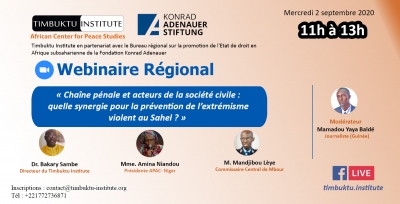
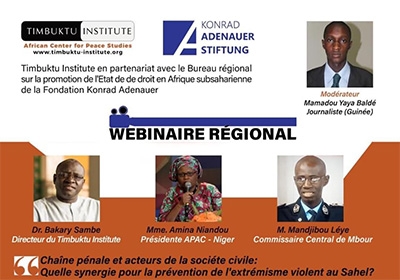
Dans cadre d’un partenariat entre le Bureau Régional de la Fondation Konrad Adenauer pour la promotion de l’Etat de Droit en Afrique et Timbuktu Institute (Dakar-Niamey), un wébinaire régional sera organisé ce mercredi 2 septembre (11H-13h) sur le thème : « Chaîne pénale et acteurs de la société civile : quelle synergie pour la prévention de l’extrémisme violent au Sahel ? ». Il sera ouvert à la participation des acteurs étatiques, des forces de sécurité et de défense de la région, des praticiens, de la société civile, des chercheurs et des experts des organisations régionales et internationales etc.
Pour Dr. Bakary Sambe, directeur de Timbuktu Institute et coordonnateur de l’Observatoire des Radicalismes et conflits religieux en Afrique (ORCRA), « les solutions strictement sécuritaires ou militaires montrent leur inefficacité et leurs insuffisances et l’aggravation de la situation dans les différents pays du Sahel invite plutôt à une valorisation des méthodes préventives y compris de la part des forces de sécurité ».
« Très souvent en contexte de lutte contre le terrorisme, on a tendance à opposer les acteurs de la chaîne pénale à ceux de la société civile notamment engagés dans la défense des droits humains. Il se trouve que cette conception de rôles opposés disperse les nombreux efforts dans cette lutte qui doit faire l’objet d’une approche holistique et inclusive », souligne Dr. Bakary Sambe qui rappelle que « ce premier webinaire d’une série soutenue par la Bureau régional pour la promotion de l’Etat de Droit initie un large débat dont l’objectif sera de faciliter davantage un dialogue serein entre tous les acteurs impliqués dans la prévention de l’extrémisme violent et la lutte contre le terrorisme ».
Par cette conférence régionale, il s’agira surtout de dégager des pistes de réflexions sur les possibilités de synergies et de coopération entre les acteurs de la société civile et de la justice pénale. L’idée est de voir dans quelle mesure « rompre d’avec la logique de l’opposition systématique des rôles » et promouvoir une meilleure collaboration dans la prévention d’un phénomène aussi complexe qui interpelle les pays de la sous-région.
Aux côtés des experts du Timbuktu Institute, Mme Amina Niandou, présidente d’APAC Niger (Section nigérienne de l’Association des professionnelles africaines de la presse) et le Commissaire de Police Mandjibou Lèye (commissaire central de Mbour), spécialiste des questions de sécurité, donneront des pistes de réflexion et d’actions pour engager les pays de la région dans la promotion d’un « dialogue constructif entre toutes les parties prenantes dans la lutte contre le terrorisme, phénomène déstructurant et déstabilisant pour les pays soucieux de consolider l’Etat de droit et la gouvernance démocratique ». Le débat ouvert au public sera modéré par le journaliste et analyste guinéen Mamadou Yaya Baldé, acteur très impliqué dans la promotion de la participation politique des jeunes en Afrique de l’Ouest et la défense des droits humains.
Par Wilfrid AHOUANSOU*
L’acte fondamental n°001/CNSP du 24 aout 2020 publié au Journal officiel, constitue sans aucun doute le véritable entracte de la crise politique au Mali, née à l’issue de la démission volontaire ou contrainte de l’ancien Président Ibrahim Boubacar Keita (IBK). Sans avoir besoin de le qualifier ainsi dans son intitulé, les membres du CNSP posent un geste fondamental, qui donne le ton sur ce que sera la suite de la transition politique.
Cet acte fondamental n’est pas pour autant commun dans les processus de transition démocratique, à l’issue d’un événement majeur : coup d’Etat, révolution populaire, conflit armé, etc. Il est inédit parce qu’il ne rentre pas aisément dans le prisme des instruments juridiques habituellement observés et qui encadre un processus de transition.
Un objet juridique difficile à identifier ?
Les processus de transition démocratique observables sur le continent africain sont pour l’essentiel gouvernés par un acte juridique fort, dont l’objectif est, soit de rassembler les différents acteurs dans une logique de consensualisme, soit de créer les bases pour la définition du futur contrat social au niveau national. Le but final de ce texte qui met en berne la constitution précédente, est quand même de créer les conditions pour un retour à l’ordre constitutionnel. C’est pour cela que la constitution est considérée comme la loi fondamentale, puisque même lorsqu’elle est mise en mal à un moment donné de l’histoire politique d’un pays, le choix ou la qualité du régime démocratique visé, justifie que l’on veuille y faire participer une grande représentation des courants politiques, idéologiques et sociales de la nation. On distingue ainsi dans ces périodes, les chartes de la transition, petites constitutions, constitutions transitoires, etc.
Les rapports entre ces normes ad’hoc et la constitution peuvent être conflictuels, au point où le Professeur Frédéric Joël AÏVO évoque un triomphe du conventionnalisme constitutionnel, pour désigner l’idée que la recherche d’un accord politique de règlement de la crise amène à mettre sous le boisseau, la constitution précédente.
Après la compétition entre la constitution et l’accord politique de transition, survient à nouveau l’ordre constitutionnel marquée par l’adoption d’une nouvelle constitution ou l’intégration des dispositions de la charte transitoire dans un processus de révision de la constitution précédente. Le Professeur Paterne MAMBO parle alors de cohabitation pacifique entre les deux types de normes, qui vise in fine à enrichir le processus démocratique et à consacrer l’hégémonie constitutionnelle.
Ces bases et échanges entre normes juridiques fondamentales sont communs aux différents processus de transition identifiés par le Professeur Mahaman Tidjani ALOU comme des moments où des acteurs politiques essaient de tirer le drap de leurs côtés en participant au mécanisme de négociation de la norme fondamentale, afin de garantir pour eux-mêmes, des conditions propices d’accession au pouvoir suprême.
C’est le but de la démocratie et l’essence même du consensualisme que les intérêts individuels des uns et des autres soient confrontés à l’intérêt général afin que se dégage un terrain commun d’entente.
Sur ces prolégomènes, peut-on identifier la place à accorder à l’acte fondamental n°001/CNSP du 24 aout 2020 ?
Il est rédigé comme son nom l’indique comme un instrument à portée générale pour gouverner la période au cours de laquelle le CSNP assumera les plus hautes fonctions de l’Etat. D’ailleurs le Président de cet organe auto-formé s’y déclare Chef de l’Etat. L’article 33 de l’acte indique qu’il « incarne l’unité nationale. Il est garant de l’indépendance nationale, de l’intégrité du territoire, du respect des traités et accords internationaux auxquels le Mali est partie. Il veille au fonctionnement régulier des pouvoirs publics ainsi qu’à la continuité de l’Etat ».
Il faut noter que l’acte fondamental du 24 aout 2020 fait référence dans son préambule à la Constitution du Mali du 25 février 1992, qu’il considère donc comme étant toujours en vigueur. Il indique également toujours dans ce préambule, la position déjà défendue par le CNSP, qu’il n’y aurait pas eu de coup d’Etat, et que ce seraient les soulèvements populaires du 18 aout 2020, qui auraient mené à la démission du Président IBK. D’autres considérants de ce préambule évoquent l’attachement aux principes démocratiques de la Charte africaine de la Démocratie, des élections et de la Gouvernance du 30 janvier 2007 et du Protocole A/SP1/1201 du 21 décembre 2001 de la CEDEAO sur la démocratie et la bonne gouvernance.
Ces références à des textes fondateurs prônant le respect des normes démocratiques et l’existence des titres I (portant sur les droits et devoirs de la personne humaine) et II (portant sur l’Etat et la souveraineté) n’enlèvent toutefois rien au caractère antinomique du but visé par l’action du CNSP, qui serait la consolidation de la démocratie.
En effet, apparaît comme un cheveu sur la soupe dans le préambule de l’acte fondamental du 24 aout 2020, la déclaration de constitution du CNSP du 19 aout 2020. Le titre III de l’acte traite également du CNSP sans s’étendre sur la qualité de ses membres et leurs attributions à part celles du Président, qui est remplacé en cas d’empêchement par un Vice-Président, suivant l’ordre de préséance déterminé par le même Comité.
L’acte fondamental n’est pas très disert sur les objectifs poursuivis par le CNSP, à part « la nécessité de fixer l’organisation provisoire des pouvoirs publics et de jeter les bases d’un Etat de droit respectueux de l’ensemble des droits et libertés de l’Homme et du Citoyen malien » et « l’urgence de doter le Mali d’organes de transition pour la conduite des affaires publiques ».
Pourtant, comme présenté plus haut, la suspension de l’ordre constitutionnel par l’ouverture de la période transitoire en raison de la démission du Président IBK dans les circonstances désormais connues, n’empêche pas un certain encadrement de la gestion de ce temps par des règles.
Des références opportunes aux textes régionaux ?
Les références aux textes régionaux sont fort à-propos en effet, notamment la Déclaration sur le cadre pour une réaction de l’OUA face aux changements anticonstitutionnels de gouvernement, héritée par l’Union Africaine (UA) et pris en considération par la CEDEAO dans son Protocole sur la démocratie et la bonne gouvernance. Si son omission par le CNSP peut se justifier par le fait qu’il se défend d’avoir effectué un coup d’Etat, le texte de la CEDEAO référencé est tout de même en porte-à-faux par rapport à certaines dispositions de l’acte fondamental.
Son article 1er indique l’interdiction de tout changement anticonstitutionnel de gouvernement, de même que tout mode non démocratique d’accession ou de maintien au pouvoir. De même, il poursuit en stipulant que « l’armée est apolitique et soumise à l’autorité politique régulièrement établie ; tout militaire en activité ne peut prétendre à un mandat politique électif ».
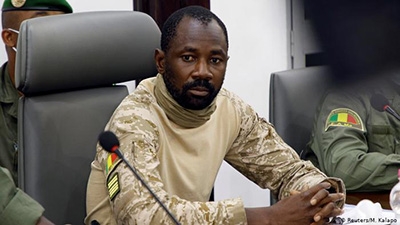
Même en arguant du fait que le Président IBK aurait démissionné par le fait de l’action populaire, le fait pour le Président du CNSP de se proclamer Chef de l’Etat, qui est un mandat électif, est en contradiction avec les textes de l’institution régionale. A fortiori, le signataire de l’acte fondamental est toujours un militaire en activité, le Colonel Assimi GOITA, Président du CNSP, ce qui d’emblée l’exclurait selon la CEDEAO à prétendre occuper cette fonction.
Au demeurant, le porte-parole du CNSP insistesur le fait que les conditions de la transition politique au Mali seront déterminés par les maliens. A moins de résumer les membres du CNSP, dont le nombre n’est pas défini par l’acte fondamental, au peuple malien, il est difficile d’appréhender l’idée que ce texte puisse constituer un instrument à vocation constitutionnelle, comme le prétend son titre VIII qui traite des dispositions finales.
Tout ou presque tout fait penser le contraire, notamment le manque de consensualisme dans l’adoption du texte, sa portée trop générale alors qu’il n’y a aucune mention de la durée de l’exercice du pouvoir par le CNSP (dont le Président se donne entre autres le droit d’accréditer des diplomates maliens et de recevoir les accréditations des diplomates étrangers), ou encore sa nature contradictoire avec des textes régionaux.
Au regard de ce qui précède, on peut dire que l’acte fondamental du 24 aout 2020 est un objet juridique non identifiable, d’abord en raison de la nature non constitutionnelle de son auteur, le CNSP n’étant prévu nul part parmi les institutions de la République pouvant prendre un texte à publier au Journal officiel. Il est également difficile d’inscrire cet acte dans la nomenclature générale des normes juridiques internes à un pays. Il n’est ni un décret, ni une loi constitutionnelle, même si le sens voulu par le CNSP est qu’il se substitue à certaines dispositions de la Constitution de 1992. Au demeurant, on peut le qualifier sans plus d’acte unilatéral, qui engage le CNSP dans la mission qu’il s’est lui-même confié au sommet de l’Etat malien.
Le CNSP, qui se réclame une certaine légitimité parce que soutenu par une partie du peuple malien, ne rêve-t-il pas trop de pouvoir comme l’accusent déjà certains de ses détracteurs ?
L’absence de référence dans cet acte fondamental à l’accord pour la paix et la réconciliation au Mali signé à Alger en 2015 ne contribue-t-elle pas à consacrer déjà une exclusion d’une frange de la population malienne représentée par certains signataires de ce précédent texte ?
Ce sont autant de questions pour lesquelles, il faut espérer une réponse dans les rebondissements futurs de la crise malienne de 2020.
Wilfrid AHOUANSOU* est Docteur en droit public de l’Université d’Abomey-Calavi
Sacré-Coeur 3 – BP 15177 CP 10700 Dakar Fann – SENEGAL.
+221 33 827 34 91 / +221 77 637 73 15
contact@timbuktu-institute.org