 French
 Arabic
 English
 Portuguese
 Spanish
 Swahili



Sacré-Coeur 3 – BP 15177 CP 10700 Dakar Fann – SENEGAL.
+221 33 827 34 91 / +221 77 637 73 15
contact@timbuktu-institute.org


Sacré-Coeur 3 – BP 15177 CP 10700 Dakar Fann – SENEGAL. +221 33 827 34 91 / +221 77 637 73 15
contact@timbuktu-institute.org
Timbuktu Institute Octobre 2026 - Semaine 1
La question de l’orpaillage reste l’une des principales actualités du pays. Cette fois-ci, il est à noter un tournant décisif : le phénomène est désormais considéré comme une question de sécurité nationale. Il ne s'agit plus seulement d'une infraction économique, mais d'un enjeu sécuritaire national pour les autorités. Pour Fidèle Sarassoro, secrétaire exécutif du Conseil national de sécurité, la lutte contre l'orpaillage illégal est « une exigence de sécurité nationale ». Ainsi, les opérations de démantèlement des sites clandestins se poursuivent et l’État reste déterminé à les éradiquer dans un délai de six mois.
L’orpaillage illégal érigé en enjeu de sécurité nationale
Pour le ministre de la Défense, Téné Birahima Ouattara, « l'État de Côte d'Ivoire est déterminé à éradiquer l'orpaillage illégal sur toute l’étendue du territoire national. Face à l'ampleur de ce phénomène, l'État ivoirien adopte une posture de fermeté. Cela doit se faire dans le strict respect de la loi et des droits des populations ». Il en appelle ainsi à la responsabilité de tous face à ce fléau qui gangrène l’économie et l'environnement. Pour ce faire, les forces de sécurité ont été dotées de centaines de véhicules le 30 septembre afin de pouvoir « mener des opérations sur terre comme sur l’eau », « de jour comme de nuit ». À cela s’ajoutent le durcissement des sanctions, notamment par le biais de l’augmentation des amendes et des peines d’emprisonnement. Pour rappel, le Groupement spécial de lutte contre l’orpaillage illégal a été créé en 2021 dans le but d'éradiquer ce phénomène.
Côte d’Ivoire : complicité affichée avec Conakry, dégel prudent avec le Sahel
Sur le plan diplomatique, Alassane Ouattara a dépêché Robert Beugré Mambé à la fête nationale de la Guinée. Les autorités ont lancé un appel solennel aux ressortissants ivoiriens pour qu'ils réservent un accueil chaleureux à leur hôte. Dans une note publiée par l’ambassade de Côte d’Ivoire en Guinée, on peut lire : « L'ambassade invite tous les Ivoiriens de Conakry à se mobiliser pour réserver au Premier ministre un accueil chaleureux, le vendredi 2 octobre 2026, à partir de 7 h, à l’aéroport international Ahmed Sékou Touré de Conakry. » Les deux pays entretiennent en effet de bonnes relations diplomatiques depuis plusieurs décennies. Cette visite est de nature à renforcer ces liens historiques de coopération entre Abidjan et Conakry. À chaque occasion, le général Mamadi Doumbouya présente Ouattara comme son grand frère, ce qui témoigne de la solidité de leurs relations. Pour rappel, il y a quelques semaines, le président guinéen était chez son homologue ivoirien dans le cadre d'une visite de travail.
Dégel diplomatique à l’épreuve des divergences sécuritaires et politiques
En outre, les relations entre la Côte d’Ivoire et le Sahel ont été au cœur de l’actualité. Ces dernières années, les rapports n'étaient pas au beau fixe ; ils étaient marqués par un climat de suspicion et des accusations récurrentes d'infiltration de la part d'États comme le Burkina Faso contre la Côte d’Ivoire. Depuis quelque temps, un dégel semble toutefois se produire. Selon Jeune Afrique, leurs relations se sont récemment renforcées, notamment pour développer la coopération et les échanges. Cette « détente » entre la Côte d’Ivoire et l’AES traduit surtout un pragmatisme dicté par la nécessité de contenir les risques sécuritaires transfrontaliers, sans pour autant effacer les divergences politiques et stratégiques. Il faut souligner que ces pays sont collectivement fragilisés par l’insécurité grandissante. Ils gagneraient à collaborer pour mieux faire face à la menace terroriste. Ainsi, ce rapprochement est de nature à réduire les tensions à court terme, mais sa consolidation dépendra de la capacité des acteurs à instaurer des mécanismes de confiance, notamment en matière de sécurité des frontières, de coopération économique et de relations avec les organisations régionales.
Timbuktu Institute October 2026 - Week 1
In Burkina Faso, the fourth anniversary of Captain Traoré’s rise to power was celebrated with great pomp by the nation. The “Night of the Popular Progressive Revolution” brought together thousands of residents on 30 September on the Place de la Résistance in Ouagadougou. Under the slogan “The people watch over the revolution”, the participants glorified the action of their leader, the man of 30 September 2022, throughout the festive evening. As a reminder, the current authorities took power in a particularly tense security context.
Between a claimed security record…
Over these years in power, they claim military successes, notably the recapture of a large part of the territory. For Prime Minister Rimtalba Jean Emmanuel Ouédraogo, “all these victories on the development front, in health, education, infrastructure, industry, food security, and so on – I am surely forgetting some. You can be proud of all these victories. Because if we have achieved all this, it is thanks to the commitment and the awakening of an entire people behind its visionary leader.” Nevertheless, civil society and international organisations point to restrictions on freedoms. In this regard, Burkinabe journalist Issouf Ouédraogo believes that this record “does not erase the current government’s difficulty in resolving crucial issues relating to the fight against corruption, freedom of expression and human rights violations”. For many observers, while major progress has indeed been made in terms of security and patriotic momentum, human rights must still be better guaranteed, particularly for politicians and journalists.
… and a civic space seen as shrinking
The record is therefore mixed. Civic space is shrinking ever further. In this regard, the Anti-Putschist Front has drawn up a list of 86 people “detained or abducted” since 2022. For them, “this is widespread repression. In practice, it is forbidden to have an opinion under this regime,” confirms one of the authors of the list, who wishes to remain anonymous. “Imagine that, for some, it was a simple comment on Facebook or WhatsApp that led to their abduction! The tragedy in this affair is that, as they have become widespread, these abductions and detentions have become commonplace…” The document entitled “Ibrahim Traoré’s disappeared” was published to shed light on, but also and above all to “denounce the authoritarianism of the junta in power in Ouagadougou and honour the memory of those who have been victims of its repression”. These accusations were brushed aside by the authorities, who continue to tout their economic and military successes.
Financial sovereignty in support of the war effort
Still in the context of the fight against terrorism, tangible results have been achieved on the ground. According to the Ministry of Economy, the Patriotic Support Fund mobilised more than 250 million CFA francs in just 9 months. The authorities published these encouraging figures for the period from 1 January to 29 September. It should be noted that this fund, created in 2023 to finance the fight against terrorism and the strengthening of national defence, is made up of, among other things, levies and taxes, levies on imported products, compulsory deductions from civil servants’ salaries, and levies on telephony and television, in order to ensure financial sovereignty. This is a Burkinabe strategy aimed at self-financing a large part of the country’s security. The supervising minister, Aboubakar Nacanabo, thanked the “valiant Burkinabe people” for all the efforts made. The fund mobilises citizens around the war in order to finance the army’s equipment and supplies.
The rise of a more specialised army in the face of the terrorist threat
Along the same lines, the authorities are stepping up the resources deployed in the fight against armed groups. On 30 September, 136 new specialist officers, trained in 29 different fields, joined the Burkinabe Armed Forces to strengthen their ranks. Graduates of the 16th class of the Georges-Namoano Military Academy, they will strengthen human and operational capacities against the insecurity that has affected the country for several years. The Chief of General Staff of the Armed Forces, Major General Moussa Diallo, who presided over the ceremony, congratulated the graduates and urged them to “remain committed to the values of honour, discipline and loyalty”. The Burkinabe authorities seem to understand that this war against terrorism requires specialists in every field: intelligence, cybersecurity, medicine, technology, and so on. Building an increasingly specialised army meets a security imperative.
Burkinabe gold: from extraction to processing, the new frontier of economic sovereignty
Mining sovereignty also made the news. The authorities are more determined than ever to ensure that gold returns to the people who own it. On 28 September, Captain Traoré announced a new stage in the nationalisation of the precious metal in Burkina Faso. At the inauguration of RAFFINOR-BF, the country’s first gold refinery, he declared that “from now on, Burkina Faso’s gold must not only be extracted in the country, it must also be processed, controlled, valorised and certified”. This is a notable step forward that requires not only political courage, but also enormous material, human and financial resources, as well as strategic partnerships. For the leader of the transition, gold must contribute to the country’s economic and social development by creating wealth and jobs. The authorities have understood that processing their resources elsewhere reduced their room for manoeuvre and slowed their progress towards sovereignty. Nationalisation also makes it possible to improve traceability and develop the country’s industrial skills. The initiative required an investment of CFA 11 billion, financed by the State through the National Company for Precious Substances of Burkina Faso (SONASP) and private partners. It already has a foundry, an analysis laboratory, a secure storage area and a jewellery unit. The remaining challenges are artisanal mining, which needs to be better regulated, as well as cross-border flows and the presence of armed groups in some mines.
Timbuktu Institute Octobre 2026 - Semaine 1
Au Burkina Faso, les quatre ans de l’arrivée au pouvoir du capitaine Traoré ont été célébrés en grande pompe par la nation. En effet, la « Nuit de la Révolution progressiste populaire » a réuni des milliers d’habitants le 30 septembre dernier sur la place de la Résistance à Ouagadougou. Sous le slogan « Le peuple veille sur la révolution », les manifestants ont magnifié l’action de leur leader, l’homme du 30 septembre 2022, pendant toute la soirée festive. Pour rappel, les autorités actuelles ont pris le pouvoir dans un contexte sécuritaire assez tendu.
Entre bilan sécuritaire revendiqué…
Durant ces années de règne, ils revendiquent des succès militaires, notamment avec la reconquête d’une grande partie du territoire. Pour le Premier ministre Rimtalba Jean Emmanuel Ouédraogo, « toutes ces victoires sur le front du développement, en matière de santé, d’éducation, d’infrastructures, d’industrie, de sécurité alimentaire, etc., c’est sûr que j’en oublie. Toutes ces victoires, vous pouvez en être fiers. Parce que si nous avons réussi tout cela, c’est grâce à l’engagement et au sursaut d’un peuple entier derrière son dirigeant visionnaire. » Néanmoins, des restrictions aux libertés sont notées de la part de la société civile et des organisations internationales. En ce sens, le journaliste burkinabè Issouf Ouédraogo estime que ce bilan « n'efface pas la difficulté du pouvoir actuel à résoudre des questions cruciales liées à la lutte contre la corruption, à la liberté d'expression et aux atteintes aux droits humains ». Pour beaucoup d’observateurs, s’il est vrai que de grandes avancées ont été notées en matière de sécurité et d'élan patriotique, il n’en demeure pas moins que les droits humains doivent davantage être garantis, notamment pour les hommes politiques et les journalistes.
… et un espace civique jugé rétréci
Il est à noter que le bilan est donc mitigé. L’espace civique se rétrécit de plus en plus. À ce propos, le Front anti-putschiste a dressé une liste de 86 personnes « séquestrées ou enlevées » depuis 2022. Pour eux, « il s'agit d'une répression généralisée ». Dans les faits, il est interdit d'avoir une opinion sous ce régime », confirme l'un des auteurs de cette liste qui souhaite rester anonyme. Imaginez que, pour certains, c'est un simple commentaire sur Facebook ou WhatsApp qui a conduit à leur enlèvement ! Le drame dans cette affaire, c'est qu'avec leur généralisation, ces enlèvements et ces séquestrations sont devenus banals… » Le document intitulé « Les disparus d'Ibrahim Traoré » a été publié pour mettre en lumière, mais aussi et surtout, « dénoncer l'autoritarisme de la junte au pouvoir à Ouagadougou et honorer la mémoire de celles et ceux qui ont été victimes de sa répression ». Des accusations balayées d’un revers de main par les autorités, qui continuent de vanter leurs succès dans les domaines économique et militaire.
La souveraineté financière au service de l’effort de guerre
Toujours dans le cadre de la lutte contre le terrorisme, des résultats probants ont été obtenus sur le terrain. Selon les services du ministère de l’Économie, le Fonds de soutien patriotique a mobilisé plus de 250 millions de FCFA en seulement 9 mois. Les autorités ont publié ces chiffres encourageants concernant la période du 1er janvier au 29 septembre. Il faut préciser que ce fonds, créé en 2023 pour financer la lutte contre le terrorisme et le renforcement de la défense nationale, est composé, entre autres, de prélèvements et de taxes, de prélèvements sur les produits importés, de retenues obligatoires sur les salaires des fonctionnaires, de prélèvements sur la téléphonie et la télévision, etc., afin d’assurer une souveraineté financière. Il s'agit d'une stratégie du Burkina Faso qui vise à financer lui-même une grande partie de sa sécurité. Le ministre de tutelle, Aboubakar Nacanabo, a tenu à remercier le « vaillant peuple burkinabè » pour tous les efforts consentis. En effet, ce fonds mobilise les citoyens autour de la guerre afin de financer les équipements et les approvisionnements de l’armée.
La montée en puissance d’une armée davantage spécialisée face à la menace terroriste
Dans la même perspective, les autorités intensifient les moyens déployés dans le cadre de la lutte contre les groupes armés. Le 30 septembre dernier, 136 nouveaux officiers spécialistes, formés dans 29 domaines différents, ont rejoint les Forces armées burkinabè pour renforcer leurs effectifs. Sortis de la 16ème promotion de l’Académie militaire Georges-Namoano, ces éléments viennent renforcer les capacités humaines et opérationnelles face à l’insécurité qui affecte le pays depuis plusieurs années. Le chef d’état-major général des armées, le général de division Moussa Diallo, qui est venu présider la cérémonie, a tenu à féliciter les récipiendaires et les a exhortés à « rester attachés aux valeurs d’honneur, de discipline et de loyauté ». Les autorités burkinabè semblent comprendre que cette guerre contre le terrorisme nécessite des spécialistes de tous les domaines : renseignement, cybersécurité, médecine, technologies, etc. La mise en place d’une armée de plus en plus spécialisée répond à un impératif sécuritaire.
Or burkinabè : de l’extraction à la transformation, le nouveau chantier de la souveraineté économique
Par ailleurs, la souveraineté minière a également fait l'actualité. Les autorités sont plus que jamais déterminées à faire en sorte que l’or revienne au peuple qui en est le propriétaire. Le 28 septembre, le capitaine Traoré a annoncé une nouvelle étape de la nationalisation du métal précieux au Burkina Faso. À l'occasion de l'inauguration de RAFFINOR-BF, la première raffinerie d’or du pays, il a affirmé que « désormais, l’or du Burkina Faso ne doit plus seulement être extrait dans le pays, il doit aussi être transformé, contrôlé, valorisé et certifié ». Il s'agit là d'une avancée notoire qui nécessite non seulement un courage politique, mais aussi la mise à disposition de moyens matériels, humains et financiers colossaux, ainsi que des partenariats stratégiques. Pour le leader de la transition, l’or doit participer au développement économique et social du pays en créant des richesses et des emplois. Les autorités ont compris que le fait de transformer leurs ressources ailleurs réduisait leur marge de manœuvre et freinait leur marche vers la souveraineté. De même, la nationalisation permet d’améliorer la traçabilité et de développer les compétences industrielles du pays. Cette initiative a nécessité un investissement de 11 milliards de FCFA, financé par l’État à travers la Société nationale des substances précieuses du Burkina Faso (SONASP) et des partenaires privés. Elle dispose déjà d'une fonderie, d'un laboratoire d'analyse, d'un espace sécurisé de stockage et d'une unité de bijouterie. Les défis restent l’exploitation artisanale, qu’il faut davantage encadrer, ainsi que les flux transfrontaliers et la présence de groupes armés dans certaines mines.
17 October 2026 · Dakaractu
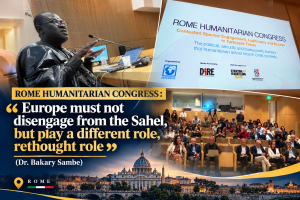
The Timbuktu Institute – African Center for Peace Studies carried the voice of the Sahel to the Rome Humanitarian Congress, held on 15 October 2026 at the Ara Pacis Museum in Rome. Organised by the Italian NGO INTERSOS on the theme “Contested Spaces: Engagement, Legitimacy and Access in Turbulent Times”, the event brought together humanitarian, diplomatic, academic and media actors to discuss the political, security and bureaucratic obstacles that hinder humanitarian action in crisis zones.
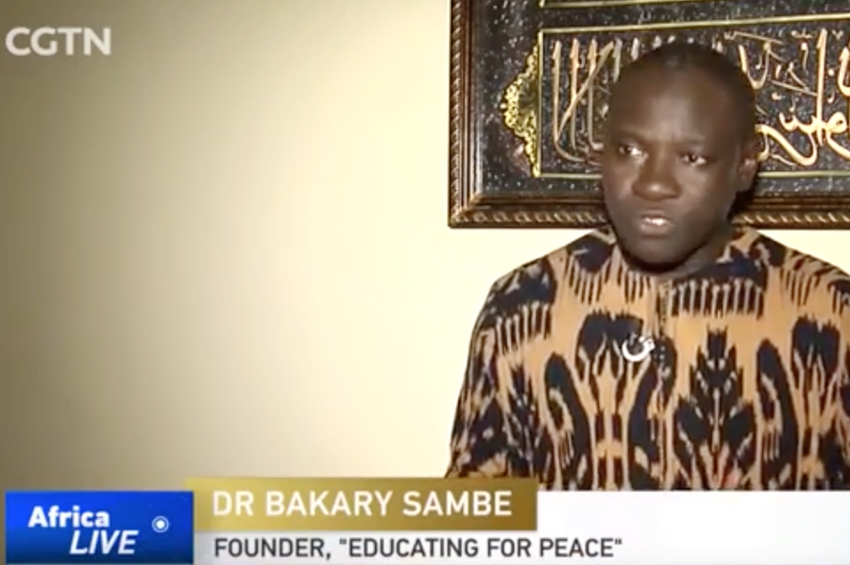
Director and Founder of the Timbuktu Institute, Dr Bakary Sambe spoke on the panel dedicated to “Humanitarian access and strategic engagement in the Sahel”. He was joined by Alda Cappelletti, Deputy Director General of INTERSOS, and Andrea Palamidessi, Head of the West and Central Africa Office at the Italian Ministry of Foreign Affairs and International Cooperation. The discussions of this high-level panel were moderated by Vincenzo Giardina, head of the international desk of the DIRE news agency.
Back from Rome, he speaks to Dakaractu about the role of humanitarians, who in his view have become “the last thread” between Europe and the Sahel, and about the need for a new vision of European engagement in the region.
Humanitarians: the last thread between Europe and the Sahel?
Dakaractu: You opened your remarks in Rome with the striking image of a humanitarian convoy. Why that choice?
Dr Bakary Sambe: Because that image says everything about the current situation. Take a humanitarian convoy between Gao and Ménaka, or on a dirt track in the Liptako-Gourma. There is no longer a European military operation, no longer a United Nations mission, and hardly any European ambassador left to talk to. In entire parts of the Sahel, that convoy is all that remains of Europe. It is the last thread. The question I asked in Rome is simple: are we going to let this last thread of solidarity break?
Dakaractu: In concrete terms, what do humanitarians represent for Sahelian populations today?
B. S : When embassies cut their staff, when cooperation agencies hesitate, when military missions pack up and cooperation programmes are suspended, who stays? Humanitarians. They are the ones still negotiating access, often with great courage and not without risk. They know the village chiefs, the women’s committees, the youth associations. For millions of Sahelians, they are, very concretely, the last human face of Europe. In the Sahel zone alone, there are more than 3 million internally displaced people, and behind that figure are their teams, working hard despite shrinking resources and the ostracism of regimes that are hostile to them.
Dakaractu: Should they, then, be entrusted with the relationship between Europe and the Sahel?
B. S : Absolutely not. That was not what I meant. I always tell European decision-makers: you cannot ask humanitarians to carry the weight of the political relationship between Europe and the Sahel on their own. They must not become diplomatic instruments. Their neutrality is one of the few guarantees of their protection in a political and security context marked above all by suspicion. If you use them as tools, you expose them, and then you lose them.
What is needed is to support them more: fund them over the long term, not according to the rhythm of media attention, which often determines the priorities of donors; protect them politically; and preserve humanitarian space. At a time when aid budgets are shrinking across much of the Western world, cutting this last link would be a historic mistake. It would be telling Sahelians: you no longer exist for us.
Dakaractu: You also directly addressed humanitarian organisations such as INTERSOS. What role do you expect NGOs to play beyond emergency response?
B. S : In my remarks in Rome, I did not ask humanitarians to become negotiators or political actors. Their neutrality must remain intact. But because they are present where no one else goes, and because they have the trust of communities, they can help create the conditions for dialogue. First, by carrying the voices of communities to where decisions are made, in Rome, Brussels or Geneva. Second, by documenting what works: local mediation, community agreements, the reintegration of young people who have left armed groups. Third, by supporting the social fabric that makes dialogue possible: education, livelihoods, psychosocial support, reconciliation between herders and farmers and between cross-border communities. And finally, by telling European decision-makers clearly that the all-military strategy has reached its limits. The Sahel does not need more weapons. It needs more trust. And trust is precisely what humanitarians have built, patiently, over the years, despite the current difficulties in the central Sahel.
Towards a new vision of European engagement
Dakaractu: Europe has been a major topic of discussion. How is Europe perceived today in the Sahel and in West Africa?
B. S : I will not use diplomatic language that would somewhat obscure the reality shown by hard evidence: Europe, and I am not talking about humanitarians, still needs to improve its image. At the Timbuktu Institute, we conducted a pilot perception survey of more than 1,100 representative respondents in Côte d’Ivoire, Niger, Senegal and Togo. The figures are harsh. 70% believe that Western partners, including the European Union, act first and foremost to protect their own security interests. 58% say the same about development aid. 61% believe that security cooperation with foreign partners does more harm than good. And these are not only AES countries: they also include coastal countries that are considered stable and, at times, friendly.
Dakaractu: Is this, then, a total rejection of Europe as such?
B. S : Not necessarily, and that is the key point. This rejection is rarely a rejection in principle. It is often a lack of knowledge. Most of the people surveyed simply do not know what Europe does. The Sahel Alliance, with its 1,200 projects, has remained invisible to ordinary citizens. At the same time, 73% get their information mainly from social media, where very effective disinformation campaigns are being waged, certainly against Europe. Europe is not only losing ground in this space. It is also losing the battle of narratives, sometimes simply by not being there or by not communicating enough about what it does.
There is also a gap in perspective. From Brussels, Paris or Rome, the Sahel is read through three words: coups, terrorism, migration. These words certainly reflect a reality. But in Kaya, Tillabéri or Mopti, the situation they describe is lived through other words: dignity, sovereignty, survival. People do not reject cooperation. They reject condescension, opacity and domination, whatever the nationality of the partner.
Dakaractu: Faced with this distrust, some in Europe are tempted to leave. What is your answer to them?
B. S : That no partner has solved the security crisis: not France, over ten years, with a regular army working in cooperation with the states of the region, and not Russia today, with Wagner mercenaries turned Africa Corps who have never changed their methods. The “Russian myth” itself is crumbling in the face of the security reality in the region, as we have seen with military setbacks in many areas of the AES countries. The Sahel has not found a saviour, and in any case it should not have expected one from outside. Instead, it has found competitors who have turned this space into an information battlefield, with a fierce war of narratives. That is precisely why Europe must not disengage: not to take back or restore yesterday’s role, but to play a different, rethought one.
Europe may at times seem to have reasons to disengage: frustration, diplomatic humiliation, fatigue, as can be perceived in the rhetoric. But it must be aware of the price of leaving. Others would immediately fill the vacuum, the crisis would spread to the coastal countries, migration flows would increase, and radicalisation explicitly targeting Europe would intensify. Staying will be costly, it is true. Leaving will cost much more, especially in terms of image.
Dakaractu: How can one stay engaged with regimes that have sometimes driven Europeans out with rhetoric that was anything but diplomatic?
B. S : I am often asked that question. My answer is simple: Europe does not engage with regimes that are hostile to it; it engages with peoples and with a shared future. The military regimes of the AES will not last forever. The history of our continent shows that transitions end, one way or another; they are parentheses in the long history of relations between our peoples. The real question is: on that day, when the regimes have passed, will Europe still have friends in the Sahel? Or will it have let an entire generation grow up convinced that it was abandoned? Total isolation only increases these countries’ dependence on other powers that do not share the same values. All studies show people’s strong attachment to democracy and freedom, despite populist rhetoric. For Europe, as for other partners, real but conditional and respectful engagement is better than a complete break, which would make no sense in light of collective security imperatives.
Dakaractu: What would this new vision, this new approach towards what you call a “Europe brand”, look like in practice?
B. S : First, moving away from the all-military approach. For more than ten years, the dominant response has been military, despite efforts on development, and violence has not receded: it has spread and changed in nature. Terrorism in the Sahel is largely endogenous. Terrorists are no longer hordes of invaders coming from abroad. Those who take up arms are often, for example, young herders who have lost their cattle, young people humiliated at checkpoints, communities that feel abandoned or stigmatised and that have become enemies of their own states, where they no longer have a place. Jihadist groups did not create these grievances; they exploited them. You do not bomb a grievance; you address it at its root.
So room must be made for dialogue, alongside security. This dialogue already exists on the ground, with local negotiations on truces and the lifting of blockades: it is carried by religious leaders, traditional chiefs, women’s networks and local peace committees. These endogenous solutions are still treated as second-class or merely alternative solutions. They must be given the dignity of a solution.
Dakaractu: But Dr. Sambe, the region has changed profoundly, and relations between states have become complex with the AES–ECOWAS rifts. Where would Europe fit in all this?
B. S : Indeed, the region has become very complex. But channels must be kept open, even indirect ones, by relying on credible intermediary countries such as Senegal, Togo, Mauritania or Algeria. No AES or ECOWAS country can move out of West Africa. They will be secure or insecure together. Humanitarians, the last faces of a Europe in retreat in some areas, must have the means to keep investing where others do not go: justice, local governance, food and pastoral security, and the border areas of Liptako-Gourma and Lake Chad, where armed groups recruit. Talking about human rights, yes: it means defending values shared with the peoples of the region; but through dialogue and discreet mechanisms, not through public statements that feed anti-Western narratives. As we say back home, you don’t mop the floor while it is still raining. Without renouncing anything, each moment has its own tempo. And finally, giving real substance to the “Europe brand”: a more collective Europe, carrying less historical baggage than bilateral engagements.
Dakaractu: The congress was held in Rome. Does Italy have a particular role to play, and what about European partners more generally?
B. S : Italy is not a spectator of the Sahel crisis: it is one of its borders. Every fragility in the Sahel eventually shows up in Lampedusa, Sicily or Calabria. The central Mediterranean route runs through Niger and then through Libya, where the Fezzan is becoming the link between Sahelian instability and the Mediterranean. But Italy also has assets: it is hardly perceived in the Sahel as a former colonial power, despite its history in the east of the continent. Like Belgium, Germany and Switzerland, it did not close the door to dialogue at critical moments, and with the Mattei Plan it has set out the ambition of a partnership between equals with Africa. It could take its full place within a European engagement based on solidarity, including all Member States, but necessarily rethought. It could embrace its de facto status as a bridge between the stability of the Sahel and that of the Mediterranean. Spain should also play this bridging role, as should France, which still has a Special Envoy for the Sahel and continues to host a large Sahelian diaspora in its universities and businesses. Its relationship with the Sahel cannot be reduced to these passing tensions, which are temporary in light of the long history it shares, and is still writing, with the countries and peoples of this region.
Dakaractu: What is the main message to take away from your time in Rome, and especially from your participation in this humanitarian congress?
B. S : Stay engaged in the Sahel, but differently: with humility, attentive listening, consistency and patience. Let us dare dialogue, which in any case will be the ultimate solution. Let us trust the solutions that Sahelians are building themselves, and support those who never left the ground, namely humanitarian organisations. Today, humanitarians are holding the last thread of the essential solidarity between Europe and the Sahel. The Sahel of tomorrow is being built today. And on that day, when the guns fall silent and the passing tensions and resentments fade away, Sahelians will remember who stood by them when all seemed lost.
Interview by Cheikh Sadibou Fall, Dakaractu.
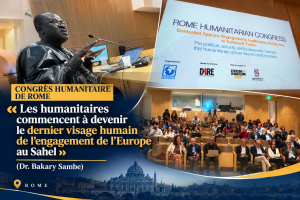
Le Timbuktu Institute – African Centre for Peace Studies a porté la voix du Sahel au Congrès Humanitaire de Rome, tenu le 15 octobre 2026 au musée de l'Ara Pacis, à Rome. Organisé par l'ONG italienne INTERSOS sur le thème « Contested Spaces: Engagement, Legitimacy and Access in Turbulent Times », ce rendez-vous a réuni des acteurs humanitaires, diplomatiques, académiques et médiatiques autour des obstacles politiques, sécuritaires et bureaucratiques qui entravent l'action humanitaire dans les zones de crise.
Directeur et Fondateur du Tombouctou Institute, Dr Bakary Sambe intervenait dans le panel consacré à « l'accès humanitaire et l'engagement stratégique au Sahel ». Il y s'exprimait aux côtés d'Alda Cappelletti, directrice générale adjointe d'INTERSOS, et d'Andrea Palamidessi, chef du bureau Afrique de l'Ouest et du Centre au ministère italien des Affaires étrangères et de la Coopération internationale. Les échanges de ce panel de haut niveau étaient modérés par Vincenzo Giardina, chef du service international de l'agence DIRE.
De retour de Rome, il revient pour Dakaractu sur le rôle des humanitaires, devenus selon lui « le dernier fil » entre l'Europe et le Sahel, et sur la nécessité d'une nouvelle vision de l'engagement européen dans la région.
Entretien…
Vous avez ouvert votre intervention à Rome avec l'image assez parlante d'un convoi humanitaire. Pourquoi ce choix ?
Parce que cette image dit tout de la situation actuelle. Prenez un convoi humanitaire entre Gao et Ménaka, ou sur une piste du Liptako-Gourma. Il n'y a plus d'opération militaire européenne, plus de mission des Nations unies, et presque plus d'ambassadeur européen à qui parler. Dans des pans entiers du Sahel, ce convoi est tout ce qui reste de l'Europe. C'est le dernier fil. La question que j'ai posée à Rome est simple : allons-nous laisser le dernier fil de solidarité se rompre ?
Concrètement, que représentent les humanitaires pour les populations sahéliennes aujourd'hui ?
Quand les ambassades fixent leurs effectifs, les agences de coopération hésitent, que les missions militaires plient bagages et que les programmes de coopération sont suspendus, qui reste ? Les humanitaires. Ce sont eux qui négocient encore l'accès, souvent avec un grand courage et non sans risques. Ils connaissent les chefs de village, les comités de femmes, les associations de jeunes. Pour des millions de Sahéliens, ils sont très concrètement le dernier visage humain de l'Europe. Rien que dans la zone sahélienne, sur compte plus de 3 millions de déplacés internes, et face à ce chiffre, il y a leurs équipes qui se démènent dans un contexte de réduction de leurs moyens et d'ostracisme de la part de régimes qui leur sont hostiles.
Faut-il alors leur confier la relation entre l'Europe et le Sahel ?
Surtout pas. Ce n'était pas le sens de ma proposition. Je le dis toujours aux décideurs européens : on ne peut pas demander aux humanitaires de porter seuls le poids de la relation politique entre l'Europe et le Sahel. Ils ne doivent pas devenir des instruments diplomatiques. Leur neutralité est l'une des rares garanties de leur protection dans un contexte politico-sécuritaire marqué surtout par la suspicion. Si vous les utilisez comme des outils, vous les exposez, et ensuite vous les perdez. Ce qu'il faut, c'est les soutenir davantage : les financeurs sur le long terme, et non au rythme de l'attention médiatique qui décide souvent des priorités des bailleurs et donateurs, les protéger politiquement et préserver l'espace humanitaire. Au moment où les budgets d'aide diminuent dans une grande partie du monde occidental, couper ce dernier lien serait une erreur historique. Ce serait dire aux Sahéliens : vous n'existez plus pour nous.
Vous avez également interpellé directement les organisations humanitaires à l'instar d'INTERSOS. Quel rôle attendez-vous des ONG au-delà de l'urgence ?
Dans mon intervention à Rome, je ne demande pas aux humanitaires de devenir des négociateurs ou des acteurs politiques. Leur neutralité doit rester intacte. Mais parce qu'ils sont présents là oùpersonne d'autre ne va, et parce qu'ils ont la confiance des communautés, ils peuvent aider à créer les conditions du dialogue. D'abord en portant la voix des communautés là où se prennent les décisions, à Rome, à Bruxelles ou à Genève. Ensuite en documentant ce qui marche : les médiations locales, les accords communautaires, la réintégration des jeunes sortis des groupes armés. Puis en soutenant le tissu social qui rend le dialogue possible : l'éducation, les moyens de subsistance, le soutien psychosocial, la réconciliation entre éleveurs et agriculteurs, entre communautés transfrontalières. Enfin, en disant clairement aux décideurs européens que la stratégie du tout-militaire a atteint ses limites. Le Sahel n'a pas besoin de plus d'armes. Il a besoin de plus de confiance. Et la confiance, c'est précisément ce que les humanitaires ont construit, patiemment, au fil des années, malgré les difficultés actuelles au Sahel central.
Il a été beaucoup question d’Europe. Justement, comment l'Europe est-elle perçue aujourd'hui au Sahel et en Afrique de l'Ouest ?
Je n'utiliserai pas le langage diplomatique qui occulterait quelque peu la réalité exprimée par des données probantes : l'Europe, je ne parle pas des humanitaires, est encore dans le besoin d’améliorer son image. Au Timbuktu Institute, nous avons mené une enquête de perception-pilote auprès de plus de 1 100 répondants représentatifs en Côte d'Ivoire, au Niger, au Sénégal et au Togo. Les chiffres sont durs. 70 % pensent que les partenaires occidentaux, Union européenne comprise, agissent d'abord pour protéger leurs propres intérêts sécuritaires. 58 % disent la même chose de l'aide au développement. 61 % estiment que la coopération sécuritaire avec des partenaires étrangers fait plus de mal que de bien. Et ce ne sont pas seulement des pays de l'AES : ce sont aussi des pays côtiers considérés comme stables et, parfois, amis.
Est-ce, donc, un rejet total de l'Europe en tant que tel ?
Pas forcément, et c'est là le point essentiel. Ce rejet est rarement un rejet de principe. C'est souvent de la méconnaissance. La plupart des personnes interrogées ne savent tout simplement pas ce que fait l'Europe. L'Alliance Sahel, avec ses 1 200 projets, est restée invisible ou plutôt pour le citoyen ordinaire. Dans le même temps, 73 % s'informent principalement sur les réseaux sociaux, où se mènent des campagnes de désinformation très efficaces et certainement contre l’Europe. L'Europe ne perd pas seulement du terrain dans cet espace. Elle perd aussi la bataille des récits, parfois simplement en n'étant pas là ou en ne communiquant pas assez sur son action. Il y a aussi un décalage de regard. Depuis Bruxelles, Paris ou Rome, on lit le Sahel à travers trois mots : coups d'État, terrorisme, migrations. Ces mots ont certes leur réalité. Mais, à Kaya, Tillabéri ou Mopti, la situation qu’ils décrivent se vit avec d'autres mots : dignité, souveraineté, survie. Les populations ne rejettent pas la coopération. Elles rejettent la condescendance, l'opacité et la domination, quelle que soit la nationalité du partenaire.
Face à cette défiance, certains en Europe sont tentés de partir. Que leur répondez-vous ?
Qu'aucun partenaire n'a résolu la crise sécuritaire, ni la France pendant dix ans avec une armée régulière en coopération avec les États de la région, ni la Russie aujourd'hui avec les mercenaires de Wagner devenus Africa Corps sans jamais changer de méthode. Le «mythe russe » lui-même s'effrite à l’épreuve de la réalité sécuritaire dans la région, on l'a vu avec les revers militaires dans de nombreuses zones des pays de l’AES. Le Sahel n'a pas trouvé de sauveur et il ne devait pas, d’ailleurs, l’espérer de l’extérieur. Il s’est trouvé des concurrents qui ont transformé cet espace en un champ de bataille informationnel avec une féroce guerre des récits. C'est justement pour cela que l'Europe ne doit pas se désengager : non pas pour reprendre ou restaurer le rôle d'hier, mais pour en jouer un autre, différent, repensé. L'Europe peut sembler avoir, quelques fois, des raisons de se désengager : la frustration, l'humiliation diplomatique, la lassitude, tel qu’on le perçoit dans les discours. Mais elle doit être consciente du prix du départ. D'autres combleraient immédiatement le vide, la crise gagnerait les pays côtiers, les flux migratoires augmenteraient et une radicalisation visant explicitement l'Europe s'accentuerait. Rester coûtera cher, il est vrai. Partir coûtera bien plus, surtout en image.
Comment rester engagé auprès de régimes qui ont parfois chassé les Européens à coup de discours tout sauf diplomatiques ?
On me pose souvent cette question. Ma réponse est simple : l'Europe ne s'engage pas auprès de régimes qui lui sont hostiles, elle s'engage auprès de peuples et d'un avenir en partage. Les régimes militaires de l'AES ne dureront pas éternellement ; l'histoire de notre continent montre que les transitions finissent, d'une manière ou d'une autre, elles sont des parenthèses sur le long cours de l’histoire des relations entre nos peuples. La vraie question est : ce jour-là, quand les régimes passeront, l'Europe aura-t-elle encore des amis au Sahel ? Ou aura-t-elle laissé toute une génération grandir avec la conviction d'avoir été abandonnée ? L'isolement total ne fait qu'accroître la dépendance de ces pays envers d'autres puissances qui n’ont pas les mêmes valeurs. Toutes les études montrent le fort attachement des populations à la démocratie et à la liberté malgré les discours populistes. Pour l’Europe comme pour d’autres partenaires, un engagement réel mais conditionnel et respectueux vaut mieux qu'une rupture complète qui serait insensée au regard des impératifs de sécurité collective.
À quoi ressemblerait, concrètement, cette nouvelle vision, cette nouvelle démarche vers ce que vous appelez une « marque Europe » ?
D'abord, sortir du tout-militaire. Depuis plus de dix ans, la réponse dominante a été militaire malgré les efforts sur le développement, et la violence n'a pas reculé : elle s'est étendue, elle a changé de nature. Le terrorisme au Sahel est largement endogène. Les terroristes ne sont plus des hordes d’envahisseurs venus de l’étranger. Ceux qui prennent les armes sont souvent, par exemple, de jeunes éleveurs qui ont perdu leur bétail, des jeunes humiliés aux postes de contrôle, des communautés qui se sentent abandonnées ou stigmatisées et devenus des ennemis de leurs propres États où ils n’ont plus droit de cité. Les groupes djihadistes n'ont pas créé ces griefs, ils les ont exploités. On ne bombarde pas un grief, on le traite à la racine. Il faut donc faire place au dialogue, à côté de la sécurité. Ce dialogue existe déjà sur le terrain avec des négociations locales de trêve et de levée de blocus : il est porté par les leaders religieux, les chefs traditionnels, les réseaux de femmes, les comités locaux de paix. Ces solutions endogènes sont, encore, traitées comme des solutions de seconde classe ou simplement alternatives. Il faut leur donner la dignité d'une solution.
Mais Dr. Sambe, la région a profondément changé et les rapports entre États sont devenus complexes avec les dissensions AES-CEDEAO. Comment l’Europe pourrait se retrouver dans tout cela ?
Effectivement, la région est devenue très complexe. Mais, il faudra garder des canaux ouverts, même indirects, en s’appuyant sur des pays intermédiaires crédibles comme le Sénégal, le Togo, la Mauritanie ou l'Algérie. Aucun pays de l’AES ou de la CEDEAO ne peut déménager de l’Afrique de l’Ouest. Ils seront en sécurité ou en insécurité ensemble. Les humanitaires, derniers visages d’une Europe en repli dans certaines zones, doivent avoir les moyens de continuer à investir là où les autres ne vont pas : la justice, la gouvernance locale, la sécurité alimentaire et pastorale, les zones frontalières du Liptako-Gourma et du lac Tchad où recrutent les groupes armés. Parler des droits humains, oui, c’est défendre des valeurs partagées avec les peuples de la région ; mais par le dialogue et des mécanismes discrets, pas par des déclarations publiques qui nourrissent les récits anti-occidentaux. On dit bien chez nous qu’on ne passe pas la serpillière alors qu’il pleut encore. Sans se renier, à chaque moment son tempo. Et enfin donner un vrai contenu à la « marque Europe » : une Europe plus collective, moins chargée de passif historique que les engagements bilatéraux.
Le congrès se tenait à Rome. L'Italie a-t-elle un rôle particulier à jouer et qu’en est-il de manière générale pour les partenaires européens ?
L'Italie n'est pas spectatrice de la crise sahélienne : elle en est l'une des frontières. Chaque fragilité du Sahel finit par se manifester à Lampedusa, en Sicile ou en Calabre. La route de la Méditerranée centrale passe par le Niger, puis par la Libye, où le Fezzan devient le trait d'union entre l'instabilité sahélienne et la Méditerranée. Mais l'Italie a aussi des atouts : elle est peu perçue au Sahel comme une ancienne puissance coloniale malgré son histoire à l’Est du continent.Comme, d’ailleurs, la Belgique, l’Allemagne ou encore la Suisse, elle n'a pas fermé la porte au dialogue aux moments critiques, et avec le plan Mattei, elle affiche l'ambition d'un partenariat d'égal à égal avec l'Afrique. Elle pourrait prendre toute sa place dans le cadre d’un engagement européen solidaire incluant tous les États-membres, mais nécessairement repensé. Elle pourrait assumer son statut de fait comme un pont entre la stabilité du Sahel et celle de la Méditerranée.L’Espagne aussi devrait jouer ce rôle de pont de même que la France qui a encore un Envoyé Spécial au Sahel et accueille toujours une forte diaspora sahélienne dans ses universités et ses entreprises. Sa relation avec le Sahel ne peut se réduire à ces velléités qui sont temporaires au regard de la longue histoire qu’elle partage et écrit encore avec les pays et peuples de cette région.
Quel message principal retenir de votre passage à Rome surtout de votre participation à ce congrès humanitaire ?
Rester engagé au Sahel, mais autrement : avec humilité, écoute bienveillante, cohérence et patience. Osons le dialogue qui de toute manière sera la solution ultime. Faisons confiance aux solutions que les Sahéliens construisent eux-mêmes, et soutenons ceux qui n'ont jamais quitté le terrain, à savoir les organisations humanitaires. Aujourd'hui, les humanitaires respectent le dernier fil de l'indispensable solidarité entre l'Europe et le Sahel. Le Sahel de demain se construit aujourd'hui. Et ce jour-là quand les armes se tairont, les velléités et les rancœurs se dissiperont, les Sahéliens se souviendront de qui était à leurs côtés quand tout semblait perdu.
Source : Dakaractu
Timbuktu Institute October 2026 - Week 1
Just over two months before the 5 December presidential election, Adama Barrow is consolidating his camp. After Mamma Kandeh, it is now Essa Faal who has joined the incumbent president, going so far as to declare the election “dead and buried”. But these endorsements come at a cost: internal dissent within APP-Sobeyaa and defections of NPP officials to a new party. Facing him, the opposition remains split between two competing coalitions, led respectively by Ousainou Darboe and Talib Bensouda, whose rapprochement is stalled over the question of a joint candidate.
An official endorsement of the incumbent president
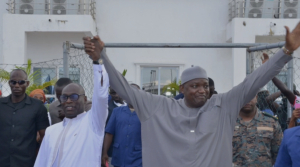
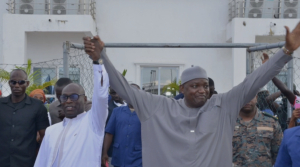
The leader of APP-Sobeyaa, Essa Faal, made official his alliance with President Adama Barrow and the National People’s Party (NPP) at a ceremony held at the presidential palace in Banjul. A video of the eventshows the two men hand in hand, arms raised, to the cheers of their supporters. A former opposition figure, Essa Faal went as far as to say that the December election was “dead and buried” and that “Barrow has already won”. During the ceremony, Adama Barrow highlighted the arithmetic of this alliance. Added to his own 2021 votes, those of Essa Faal and of Mamma Kandeh, who joined the NPP at the end of July, would make his re-election a foregone conclusion. This choice is, however, contested within APP-Sobeyaa, where several founding members and officials disapprove of an alliance that leads their leader to give up running in the 5 December vote. Essa Faal also denied having received money or sought a post in exchange for his support.
The presidential party faces a wave of defections
At the very moment it was celebrating Essa Faal’s endorsement, the NPP saw some twenty of its officials join the National Democratic Party (NDP), founded by Kebba Madi Bojang, former youth president of the ruling party. Youth coordinators, women’s wing leaders and members of constituency executives, the defectors from several regions of the country say they had only been active in the NPP because of Kebba Madi Bojang, whom they have now “decided to follow”. Although these departures remain limited in number, they affect the grassroots activist apparatus of the ruling party just over two months before the presidential election.
Divided, the opposition debates a rapprochement between Ousainou Darboe and Talib Bensouda
Faced with this strategy of endorsements, the opposition is going into the election in disarray. Two coalitions are competing: Gambia First, built around Ousainou Darboe’s United Democratic Party (UDP), and Coalition 2026, led by the Mayor of Kanifing, Talib Ahmed Bensouda, and his Unite movement. On social media, a UK-based Unite supporter revived the debate by calling on the two men to “find a path of convergence”. “Politics is the art of the possible. Yesterday’s differences must not become tomorrow’s obstacles,” he argued, recalling that rivals of the president, such as Mamma Kandeh and Essa Faal, had managed to find common ground with the NPP. The appeal drew mixed reactions. While several users urged the two leaders to “put the national interest above personal differences”, others pointed to the practical obstacles to such a rapprochement, starting with the question of who would lead the coalition as its candidate.
For his part, Ousainou Darboe opted for a firm stance. Addressing the UDP diaspora convention in London on 27 September, he praised three decades of loyalty from party members abroad, before lashing out at politicians willing to abandon their principles for personal or political gain, a criticism that sounds like an allusion to the recent defections to the presidential camp. “The truth has no expiry date,” he said. Ousainou Darboe stated that his party remains open to working with other movements that share the UDP’s values and named Adama Barrow as the only opponent in this election.
Timbuktu Institute Octobre 2026 - Semaine 1
À un peu plus de deux mois de la présidentielle du 5 décembre, Adama Barrow consolide son camp. Après Mamma Kandeh, c’est Essa Faal qui rejoint le président sortant, au point de déclarer l’élection « morte et enterrée ». Mais ces ralliements ont un coût : contestations internes à l’APP-Sobeyaa et défections de cadres du NPP au profit d’un nouveau parti. Face à lui, l’opposition reste partagée entre deux coalitions concurrentes, celle d’Ousainou Darboe et celle de Talib Bensouda, dont le rapprochement bute sur la question du candidat commun.
Un ralliement officialisé au président sortant
Le chef de file de l’APP-Sobeyaa, Essa Faal, a officialisé son alliance avec le président Adama Barrow et le National People’s Party (NPP) lors d’une cérémonie organisée au palais présidentiel de Banjul. Une vidéo de l’événement, montre les deux hommes main dans la main, les bras levés, sous les acclamations de leurs partisans. Ancien opposant, Essa Faal est allé jusqu’à affirmer que l’élection de décembre était « morte et enterrée »et que « Barrow a déjà gagné ». Lors de la cérémonie, Adama Barrow a mis en avant l’arithmétique de ce rapprochement. Additionnés à ses propres suffrages de 2021, ceux d’Essa Faal et de Mamma Kandeh, rallié au NPP depuis la fin juillet, rendraient sa réélection acquise. Ce choix est toutefois contesté au sein de l’APP-Sobeyaa, dont plusieurs membres fondateurs et cadres désapprouvent un ralliement qui conduit leur chef à renoncer à se présenter au scrutin du 5 décembre. Essa Faal s’est par ailleurs défendu d’avoir reçu de l’argent ou sollicité un poste en échange de son soutien.
Le parti présidentiel confronté à une vague de défections
Au moment même où il célébrait le ralliement d’Essa Faal, le NPP a vu une vingtaine de ses cadres rejoindre le National Democratic Party (NDP), fondé par Kebba Madi Bojang, ancien président de la jeunesse du parti présidentiel. Coordinateurs de jeunesse, responsables de l’aile féminine ou membres d’exécutifs de circonscription, les démissionnaires issus de plusieurs régions du pays affirment n’avoir milité au NPP qu’en raison de la présence de Kebba Madi Bojang, qu’ils ont désormais « décidé de suivre ». Si ces départs restent limités en nombre, ils touchent l’appareil militant de base du parti au pouvoir, à un peu plus de deux mois de la présidentielle.
Divisée, l’opposition débat d’un rapprochement entre Ousainou Darboe et Talib Bensouda
Face à cette stratégie de ralliements, l’opposition aborde le scrutin en ordre dispersé. Deux coalitions se font concurrence : Gambia First, structurée autour de l’United Democratic Party (UDP) d’Ousainou Darboe et Coalition 2026, emmenée par le maire de Kanifing, Talib Ahmed Bensouda et son mouvement Unite. Sur les réseaux sociaux, un sympathisant d’Unite basé au Royaume-Uni a relancé le débat en appelant les deux hommes à « trouver un chemin de convergence ». « La politique est l’art du possible. Les différences d’hier ne doivent pas devenir les obstacles de demain », a-t-il plaidé, rappelant que des rivaux du président, à l’image de Mamma Kandeh et d’Essa Faal, avaient su trouver un terrain d’entente avec le NPP. L’appel a suscité des réactions contrastées. Si plusieurs internautes ont exhorté les deux dirigeants à « placer l’intérêt national au-dessus des différences personnelles », d’autres ont pointé les obstacles concrets d’un tel rapprochement, à commencer par la question du candidat à la tête de cette coalition.
De son côté, Ousainou Darboe a privilégié un discours de fermeté. Devant la convention de la diaspora de l’UDP réunie à Londres le 27 septembre, il a salué trois décennies de loyauté de ses militants à l’étranger, avant de fustiger les responsables politiques prêts à abandonner leurs principes pour un avantage personnel ou politique, une critique qui sonne comme une allusion aux récents ralliements au camp présidentiel. « La vérité n’a pas de date d’expiration », a-t-il affirmé. Ousinou Darboe a assuré que son parti reste ouvert à la perspective de collaborer avec d’autres mouvements qui partagent les valeurs de l’UDP et a désigné Adama Barrow comme le seul adversaire de cette élection.
Timbuktu Institute October 2026 - Week 1
At the UN, the Bissau-Guinean transition is promising an “inclusive, free, transparent and credible” vote on 6 December. On the ground, however, political space continues to shrink. Former President Umaro Sissoco Embaló, a declared candidate, has been barred from returning by the Military High Command, which cited security reasons. This decision lends itself to two readings: a genuine rupture between the junta and its former mentor, or a staged move to pave the way for his return. The review of his candidacy, in light of the residency requirement set by the new Constitution, will show which one prevails.
Promise of “credible” general elections
Before the United Nations General Assembly, the transitional Prime Minister, Ilídio Vieira Té, pledged that the 6 December vote would be held in an “inclusive, free, transparent and credible” manner. This promise, however, contrasts with developments in the domestic political situation. From the ban on political meetings decided in January to the seizure of the PAIGC headquarters at the end of September, the space left to the opposition has steadily shrunk since the start of the transition.
Umaro Sissoco Embaló prevented from returning to Bissau
Overthrown in a military coup on 26 November 2025, former President Umaro Sissoco Embaló announced at the end of September in an interview with Jeune Afrique that he would be a candidate in the 6 December election, under the banner of the Republican Platform. From exile, he said he intended to return to Guinea-Bissau on 4 October. Initially, the transitional government’s spokesman, Fernando Vaz, recalled “the inalienable right of every Bissau-Guinean citizen to return to their country” and deemed his candidacy “admissible in principle”. But three days before the announced date of his return, the Military High Command issued an official statement closing the door to the former president’s return, citing “security conditions” that were not currently met. The statement also reaffirmed that restrictive measures remain in force, including the ban on demonstrations, gatherings and political meetings. Following this decision, Umaro Sissoco Embaló called on his supporters to remain calm, while stating that he remained “determined” to pursue his presidential bid.
Genuine rupture or staged move? Two readings of the same decision
The first reading of this situation is that of a total rupture between the junta and Embaló. The ban on his return would then be part of the gradual lockdown of political space by the transitional authorities, who would be targeting a potential rival. The military officers previously considered close to him would now be seeking to free themselves from his influence. The second reading is that of a staged move intended to preserve, or even restore, the former president’s influence. The measure could then be part of a broader strategy that some describe as a “fake coup”. As early as November 2025, opponents and some observers suspected Embaló of having orchestrated the putsch himself in order to halt an electoral process whose victory the opposition was claiming. These accusations rested in particular on the links between the former president and several figures now at the heart of the transition. The transitional president, General Horta Inta-A Na Man, had been his personal chief of staff and then Army Chief of Staff, while the transitional Prime Minister, Ilídio Vieira Té, had been his Minister of Finance.
The new Constitution, approved by referendum on 30 August and significantly strengthening presidential prerogatives, also lends weight to this second reading. Embaló, who had dissolved the National Assembly several times, had indeed shown himself to be opposed to the principle of separation of powers. For opposition figure Agnelo Regalla, this constitutional change makes it possible to “create favourable ground for Umaro Sissoco Embaló to regain presidential power ”. PAIGC President Domingos Simões Pereira takes the same view, arguing that the manoeuvre aims to “keep trusted elements” in power until the conditions for the former president’s return are met.
One legal factor could, however, call this second reading into question. The new Constitution requires five years of continuous residence in the country in order to run in the presidential election. A former president who has been living abroad for several months could therefore, in principle, fail to meet this requirement. The review of his candidacy will thus be the real test: if it is validated despite this provision, it would support the collusion theory; if it is rejected, it would reinforce the rupture theory.
Timbuktu Institute Octobre 2026 - Semaine 1
À l’ONU, la transition bissau-guinéenne promet un scrutin « inclusif, libre, transparent et crédible » le 6 décembre. Sur place, l’espace politique continue pourtant de se réduire. Candidat déclaré, l’ancien président Umaro Sissoco Embaló s’est vu interdire son retour par le Haut commandement militaire, invoquant des raisons de sécurité. Cette décision se prête à deux lectures : une rupture réelle entre la junte et son ancien mentor, ou une mise en scène au service de son retour. L’examen de sa candidature, au regard de la condition de résidence fixée par la nouvelle Constitution, dira laquelle l’emporte.
Promesse de tenue d'élections générales « crédibles »
Devant l’Assemblée générale des Nations unies, le Premier ministre de transition, Ilídio Vieira Té, s’est engagé à ce que le scrutin du 6 décembre se déroule de manière « inclusive, libre, transparente et crédible ». Cette promesse contraste toutefois avec l’évolution de la situation politique intérieure. De l’interdiction des réunions politiques décidée en janvier, à la saisie du siège du PAIGC fin septembre, l’espace laissé à l’opposition n’a cessé de se réduire depuis le début de la transition.
Umaro Sissoco Embaló empêché de rentrer à Bissau
Renversé le 26 novembre 2025 par un coup d’État militaire, l’ancien président Umaro Sissoco Embaló a annoncé fin septembre dans un entretien accordé à Jeune Afrique qu’il serait candidat à l’élection du 6 décembre, sous la bannière de la Plateforme républicaine. Depuis son exil, il a indiqué vouloir rentrer en Guinée-Bissau le 4 octobre. Dans un premier temps, le porte-parole du gouvernement de transition, Fernando Vaz, a rappelé « le droit inaliénable de tout citoyen bissau-guinéen à rentrer dans son pays » et jugé sa candidature « recevable sur le principe ». Mais trois jours avant la date annoncée de son retour, le Haut commandement militaire a publié un communiqué officiel fermant la porte au retour de l’ancien président, invoquant des « conditions de sécurité » qui ne seraient pour l’heure pas réunies. La déclaration réaffirme également le maintien des mesures restrictives en vigueur, notamment l’interdiction des manifestations, des rassemblements et des réunions à caractère politique. Suite à cette décision, Umaro Sissoco Embaló a appelé ses partisans au calme, tout en affirmant rester « déterminé » à poursuivre sa démarche pour la présidentielle.
Rupture réelle ou mise en scène ? Deux lectures d’une même décision
La première lecture de cette situation est celle d’une rupture totale entre la junte et Embaló. L’interdiction de son retour s’inscrirait alors dans le contexte de verrouillage progressif de l’espace politique par les autorités de transition qui viseraient un rival potentiel. Les militaires qui lui étaient auparavant réputés proches chercheraient désormais à s’affranchir de son influence. La seconde lecture est celle d’une mise en scène destinée à préserver, voire à rétablir, l’influence de l’ancien président. La mesure pourrait alors s’intégrer dans une stratégie plus large, que certains qualifient de « faux coup d’État ». Dès novembre 2025, des opposants et certains observateurs avaient soupçonné Embaló d’avoir lui-même orchestré le putsch afin d’interrompre un processus électoral dont l’opposition revendiquait la victoire. Ces accusations reposaient notamment sur les liens entre l’ancien président et plusieurs figures aujourd’hui au cœur de la transition. Le président de transition, le général Horta Inta-A Na Man, avait ainsi été son chef d’état-major particulier puis chef d’état-major de l’armée de terre, tandis que le Premier ministre de transition, Ilídio Vieira Té, était son ministre des Finances.
La nouvelle Constitution, approuvée par référendum le 30 août et renforçant sensiblement les prérogatives présidentielles, alimente également cette seconde lecture. Embaló, qui avait dissous à plusieurs reprises l’Assemblée nationale, s’était en effet montré opposé au principe de séparation des pouvoirs. Pour l’opposant Agnelo Regalla, cette modification constitutionnelle permet de « créer un terrain favorable à la reprise du pouvoir présidentiel par Umaro Sissoco Embaló ». Même son de cloche chez le président du PAIGC, Domingos Simões Pereira, pour qui la manœuvre viserait à « maintenir des éléments de confiance » au pouvoir jusqu’à ce que les conditions du retour de l’ancien président soient réunies.
Un élément juridique pourrait toutefois remettre en cause cette seconde lecture. La nouvelle Constitution impose en effet cinq années de résidence continue dans le pays pour pouvoir se présenter à l’élection présidentielle. Un ancien président installé à l’étranger depuis plusieurs mois pourrait donc, en principe, ne pas satisfaire cette condition. L’examen de sa candidature constituera dès lors le véritable révélateur : validée malgré cette disposition, elle accréditerait la thèse d’une connivence ; rejetée, elle renforcerait celle de la rupture.
Timbuktu Institute October 2026 - Week 1
Unanimous tributes to Sidya Touré despite the dissolution of his party, Alpha Condé’s indictment of restrictions on freedoms, NGO warnings about enforced disappearances seventeen years after the 28 September massacre: in Guinea, the question of political and human rights remains unresolved.
Death of Sidya Touré: the Guinean political class pays tribute to an opposition figure
Former Prime Minister (1996-1999) and President of the Union of Republican Forces (UFR), Sidya Touré, died on 25 September in Paris at the age of 81. His death prompted many tributes across the Guinean political class, starting with that of another former Prime Minister, Cellou Dalein Diallo, who hailed a “fellow traveller and comrade in struggle”. Prime Minister Bah Oury visited the family of the deceased to offer his condolences and those of the President of the Republic. He expressed the government’s wish that “the man who wanted to lead Guinea may rest in Guinea”, while stating that he would defer to the family’s decision. This solicitude contrasts with the fate of his political party: the UFR was among the forty parties dissolved last March.
Alpha Condé defends his record and denounces restrictions on political space
In a message posted on Facebook, the former President of the Republic (2010-2021) drew up a positive assessment of his presidency, highlighting in particular economic and financial reforms as well as his achievements in energy, infrastructure, mining, education and health. Alpha Condé also acknowledged that this period had been marked by political tensions and deadly demonstrations. Going on the offensive, the former president then sharply criticised the country’s current political situation. Listing “the restriction of civic space, the banning of demonstrations, the arrests of journalists and opponents, the forced exile of some Guineans, the closure or suspension of media outlets, as well as cases of enforced disappearances outside any legal and regular procedure and the suspicious deaths of many Guineans”, he took up the grievances voiced by human rights organisations. This indictment is nonetheless marked by ambiguity, since his own regime was also subject to similar criticism.
Seventeen years after the 28 September massacre, the human rights situation remains “worrying”, according to NGOs
On the 17th anniversary of the Conakry stadium massacre, the International Federation for Human Rights (FIDH), the Guinean Organisation for the Defence of Human Rights (OGDH) and the Association of Victims, Relatives and Friends of 28 September (AVIPA) denounced the slowness of the compensation mechanism. Of the 334 victims recognised by the first-instance judgment, fewer than 200 had been compensated by last May. The FIDH president also raised the alarm about the current human rights situation in the country, describing enforced disappearances as a “major problem” for Guinea. According to him, “the authorities cannot remain silent in the face of these disappearances”. For Alexis Deswaef, it is indeed “difficult not to make the connection” between these disappearances and the discovery at the end of August of a mass grave in Forécariah, where six bodies were found with their hands tied and their eyes and mouths covered. Received by the Prosecutor General on this matter, the FIDH president regretted that the magistrate had “hidden behind the confidentiality of investigations”, while some twenty African civil society organisations are calling for an “independent, impartial and transparent” investigation.
Sacré-Coeur 3 – BP 15177 CP 10700 Dakar Fann – SENEGAL.
+221 33 827 34 91 / +221 77 637 73 15
contact@timbuktu-institute.org